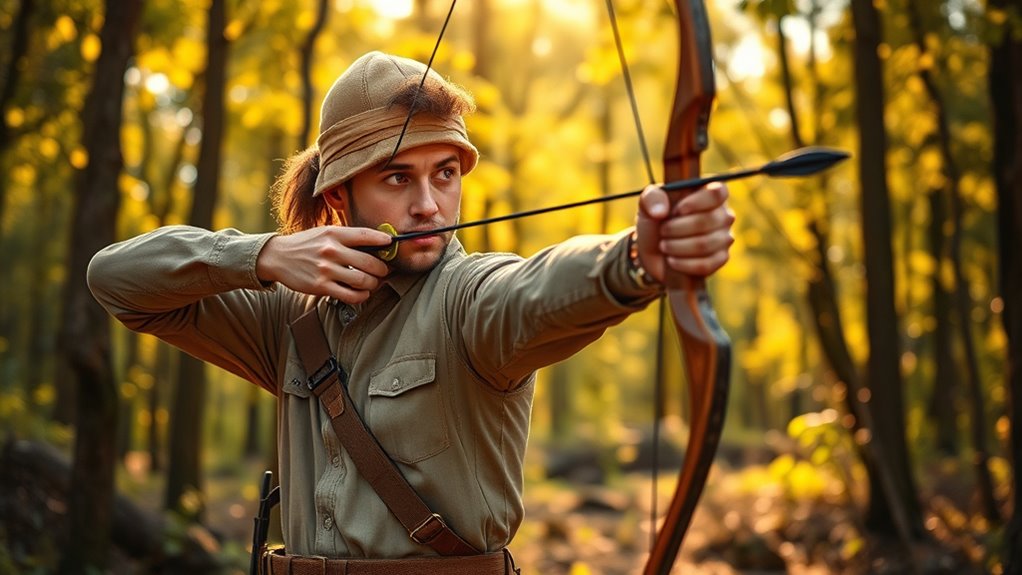
Master Aiming a Recurve Bow Without a Sight in 7 Simple Steps
Master aiming a recurve bow without a sight by following these essential techniques. Developing a solid stance is the first step—position your feet shoulder-width apart and keep your body perpendicular to the target. This foundation helps improve stability and accuracy.
Focus on establishing a consistent anchor point, such as your mouth or chin, to maintain uniformity in your shots. Use the bowstring as a guide to align the arrow tip precisely with your target. These practices build muscle memory, which is crucial for reliable shooting.
Control your breathing to stay calm and steady during each shot, and maintain sharp mental focus. Pay attention to feedback from each arrow and make aim adjustments based on the conditions.
Stick with these steps, and you’ll quickly refine your skill and master shooting a recurve bow without a sight.
Key Takeaways
- Focus on your dominant eye and consistently anchor the string at a familiar point like the mouth or chin.
- Stand with feet shoulder-width apart and body perpendicular to the target for a stable shooting stance.
- Align the arrow tip with the target using the bow’s riser or arrow rest, relying on visual and tactile cues.
- Practice smooth, controlled releases while maintaining steady breathing to improve accuracy and muscle memory.
- Adjust aim based on shot feedback and environmental factors like wind and terrain for consistent grouping.
Learn the Basics of Recurve Bow Aiming Without a Sight
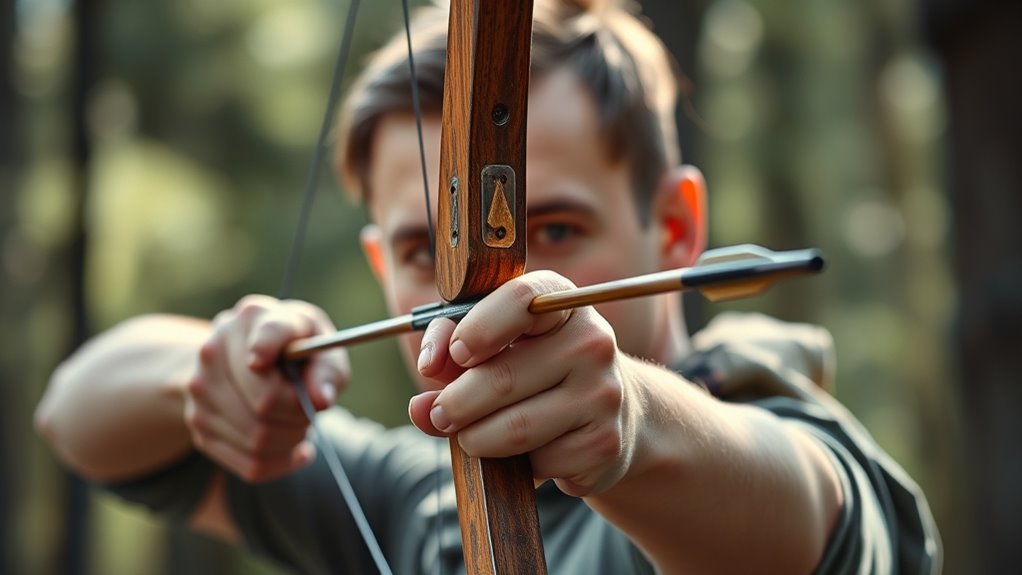
Before you can hit your target consistently without a sight, you need to understand the fundamentals of aiming with a recurve bow. First, focus on your dominant eye, as it guides your aim. Close your non-dominant eye to reduce distractions, or slightly squint it if closing feels uncomfortable.
Next, draw the bowstring to your anchor point, usually the corner of your mouth or chin, ensuring it’s consistent every time. Align the tip of the arrow with your target, using the bow’s riser or arrow rest as a reference point. Remember, you’re not looking through a sight; instead, you’re relying on muscle memory and visual cues from the bow and arrow.
Breathing control matters too—steady your breath before releasing. Finally, practice releasing smoothly without jerking the string. Mastering these basics sets a solid foundation, making your shots more accurate and reliable, even without any mechanical aids.
Perfect Your Stance for Accurate Recurve Bow Aiming
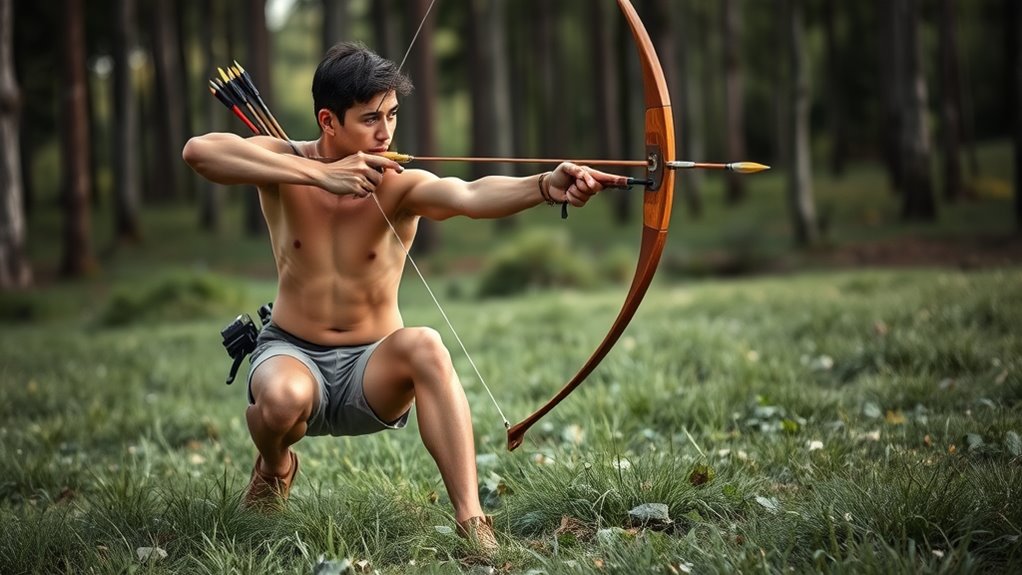
While aiming is essential, your stance forms the foundation for consistent accuracy with a recurve bow. Without a solid, repeatable stance, your shots will vary no matter how well you focus on the target. To perfect your stance, keep these key points in mind:
- Stand with your feet shoulder-width apart for stability.
- Position your body perpendicular to the target, creating a 90-degree angle.
- Distribute your weight evenly on both feet, keeping a slight bend in your knees.
- Keep your shoulders relaxed and aligned with your feet to avoid tension.
- Maintain an upright posture, avoiding leaning forward or backward.
Master Anchor Points for Consistent Shot Accuracy
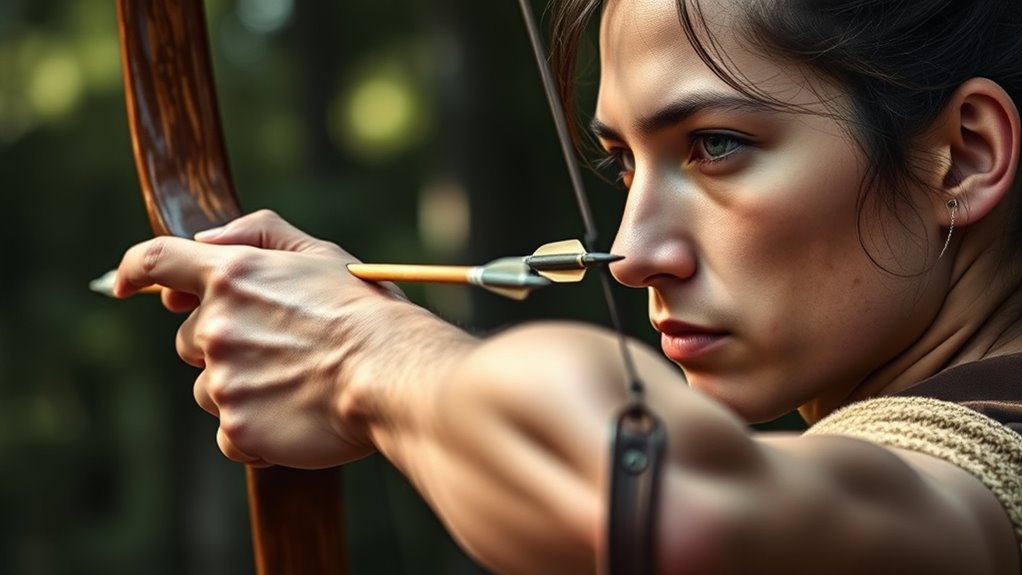
To shoot accurately without a sight, you need to define a clear anchor point on your face. Consistently placing your hand or string at that exact spot helps build muscle memory over time.
This consistency is key to making every shot repeatable and precise.
Defining Your Anchor Spot
When you’re aiming a recurve bow without a sight, defining your anchor spot becomes essential for consistent shot accuracy. Your anchor spot is that precise point on your face where your drawing hand settles every time before release. It acts like a natural reference, helping your brain register where the arrow will fly.
To define your anchor spot, focus on these key elements:
- Tip of your index finger touching the corner of your mouth
- String touching the tip of your nose or chin
- Drawing hand firmly pressing against your jawline
- Consistent placement of your thumb near your cheekbone
- Feeling the tension evenly distributed in your fingers
Locking in this spot ensures your shots remain steady and reliable, even without a sight.
Consistency In Anchor Placement
Because your anchor spot serves as your aiming foundation, maintaining consistency in its placement is essential for repeatable accuracy. Every time you draw the bow, you want your hand, string, and face to meet at the exact same point. This uniformity minimizes variables that can throw off your shot.
Pay close attention to how your fingers rest on the string and where your draw hand touches your face—whether it’s the corner of your mouth, chin, or cheekbone. Use tactile cues like the feel of the string against your nose or the pressure on your jaw to confirm placement.
Muscle Memory Development
Although nailing down a consistent anchor point takes practice, developing muscle memory is key to making it second nature. When you repeat the same motion, your muscles learn the exact position and tension needed for each shot, reducing guesswork and improving accuracy.
To build this muscle memory, focus on:
- Placing your hand against the same spot on your face every time
- Feeling the bowstring rest firmly at your anchor point
- Drawing the bow smoothly until your hand touches your cheek or jawline
- Maintaining consistent tension in your back and shoulder muscles
- Releasing the string with the same finger and motion
Aim Using Your Bowstring and Arrow as Guides
You’ll want to line up your bowstring directly with the target to create a natural aiming reference. Positioning your arrow carefully along this line helps guarantee your shot stays true.
Aligning Bowstring With Target
When aiming without a sight, aligning your bowstring with the target becomes essential for accuracy. You’ll use the bowstring as a vertical guide, aiming it so it appears to bisect your target. To do this effectively:
- Focus your eyes on the target’s center.
- Position the bowstring so it runs straight up and down, aligned with that center.
- Keep the string’s nock point (where the arrow attaches) visible and steady.
- Ensure the bowstring doesn’t wobble as you draw and release.
- Visualize the string as an invisible line connecting your hand, bow, and target.
This alignment creates a consistent reference point that helps you shoot true without a sight. With practice, you’ll instinctively know how to position the string for precise aiming in every shot.
Positioning Arrow For Accuracy
Since your bowstring serves as a vertical guide, positioning the arrow correctly alongside it is essential for accurate aiming. You’ll want the arrow shaft to line up just to the side of the bowstring, creating a clear reference point. This alignment helps you visualize a straight path to your target.
When you nock the arrow, verify it rests firmly on the arrow rest without wobbling. Check that the arrow tip aligns with your intended point of impact, adjusting your hand position if needed. By using the bowstring as a vertical line and the arrow as a horizontal guide, you create a natural crosshair.
With consistent practice, this simple method boosts your precision without relying on sights.
Build Muscle Memory With Focused Practice
Although aiming without a sight might seem intimidating at first, building muscle memory through focused practice will make it feel natural over time. You’ll develop instinctive movements that guide your shots with consistent accuracy. Start by repeating the same stance and draw length until it feels automatic.
Pay attention to how your muscles engage and relax with each shot.
Here’s how to build muscle memory effectively:
- Practice the same draw and anchor point every session
- Use consistent finger placement on the string
- Maintain steady posture and shoulder alignment
- Shoot at close targets to reinforce form before increasing distance
- Repeat slow, deliberate shots focusing on smooth release
Control Your Breathing and Mental Focus
To shoot accurately without a sight, you’ll need to control your breathing and maintain sharp mental focus. Begin by taking slow, deep breaths to calm your body and steady your hands. As you draw the bowstring, inhale deeply, then hold your breath briefly at full draw to minimize movement.
Exhale gently after releasing the arrow to keep your posture relaxed.
Mental focus is just as essential. Clear your mind of distractions and concentrate fully on your target and form. Visualize the arrow’s flight path and trust your muscle memory.
Avoid overthinking the shot; instead, stay present in the moment. Practicing mindfulness techniques, like focusing on your breath or repeating a calming phrase, can sharpen your concentration during shooting sessions.
Adjust Aim Based on Feedback and Conditions
When you shoot without a sight, you’ll need to constantly adjust your aim based on the feedback you get from each shot and the changing conditions around you. After every arrow, watch where it lands and identify if you’re consistently hitting left, right, high, or low. This information is vital for making precise corrections.
Shooting without a sight requires constant aim adjustments based on each shot’s feedback and environmental changes.
Environmental factors like wind or lighting can also throw off your shot, so stay alert and ready to adapt.
To help you visualize adjustments, keep these points in mind:
- If arrows cluster left, aim slightly more to the right next time.
- When shots land low, raise your aim or adjust your anchor point.
- Notice wind direction and speed; compensate by aiming into the wind.
- Bright sunlight might affect your sighting; adjust your focus accordingly.
- Vary your shot angle on uneven terrain to maintain consistency.
Frequently Asked Questions
What Type of Arrows Work Best With Recurve Bows Without Sights?
You’ll want arrows that are lightweight yet sturdy, like carbon or aluminum. They offer consistent flight and durability, helping you maintain accuracy even without a sight.
Make sure they match your bow’s draw weight for best results.
How Do Weather Conditions Affect Shooting Accuracy Without a Sight?
Wind’s like a mischievous spirit, throwing your arrow off course, while rain blurs your focus and chills your grip. You’ll need to adjust your aim and stance, trusting instincts more when weather plays tricks on you.
Can Beginners Use Recurve Bows Without Sights Safely?
Yes, you can safely use a recurve bow without sights as a beginner, but you’ll need proper instruction and practice. Always prioritize safety gear, clear surroundings, and follow guidance to build confidence and accuracy gradually.
Starting without sights can help develop better instinctive shooting skills. Make sure to practice in a controlled environment and never shoot without supervision if you are unsure.
Consistent practice and patience are key to mastering the bow safely and effectively.
What Maintenance Is Required for a Recurve Bow Used Without a Sight?
Want your recurve bow to stay reliable? You’ll need to regularly check for cracks, keep the string waxed, and guarantee limbs aren’t warped.
Don’t forget to clean it after use—would you want dirt affecting your shot?
Are There Specific Recurve Bow Brands Recommended for Sightless Aiming?
You’ll find brands like Samick, Bear Archery, and PSE popular for sightless aiming because they offer excellent balance and smooth draw.
Choose a bow that feels comfortable and suits your draw length for best results.
Conclusion
With every draw, you become the steady hand that tames the wild wind. Trust your stance, feel the rhythm of your breath, and let your arrow dance with precision through the air.
Without a sight, you’re not just aiming—you’re crafting a silent symphony of focus and muscle memory. Embrace each shot as a step closer to mastery, where instinct and skill weave together.
Master aiming a recurve bow without a sight requires patience and practice. Each release becomes a soaring whisper of success, proving that true accuracy comes from within.