How to Use a Sight on a Bow in 7 Simple Steps
To use a sight on your bow effectively, start by choosing the right sight type that suits your bow and shooting style. A well-chosen bow sight enhances your aiming precision and overall archery performance.
Next, securely mount the sight onto your bow, ensuring it is level for accurate alignment. Adjust the pins to correspond with your typical target distances, which helps in hitting your mark consistently.
Align your sight carefully for precise aiming, then spend ample time practicing to build consistency with your shots. Fine-tune the adjustments based on your results to improve accuracy over time.
Finally, keep your sight clean and well-maintained to prevent any issues. With continuous practice and proper care, you’ll discover tips to perfect your setup and boost your shooting accuracy even more.
Key Takeaways
- Securely mount the bow sight and ensure it is level using a bubble level or built-in leveling features.
- Assign pins to specific yardages and practice shooting at known distances to verify accuracy.
- Make small, incremental adjustments to windage and elevation based on shot groupings.
- Practice regularly in varied conditions to develop muscle memory and improve eye coordination.
- Maintain the sight by tightening screws, cleaning lenses, and re-zeroing pins as needed.
Choose the Right Bow Sight for Your Setup
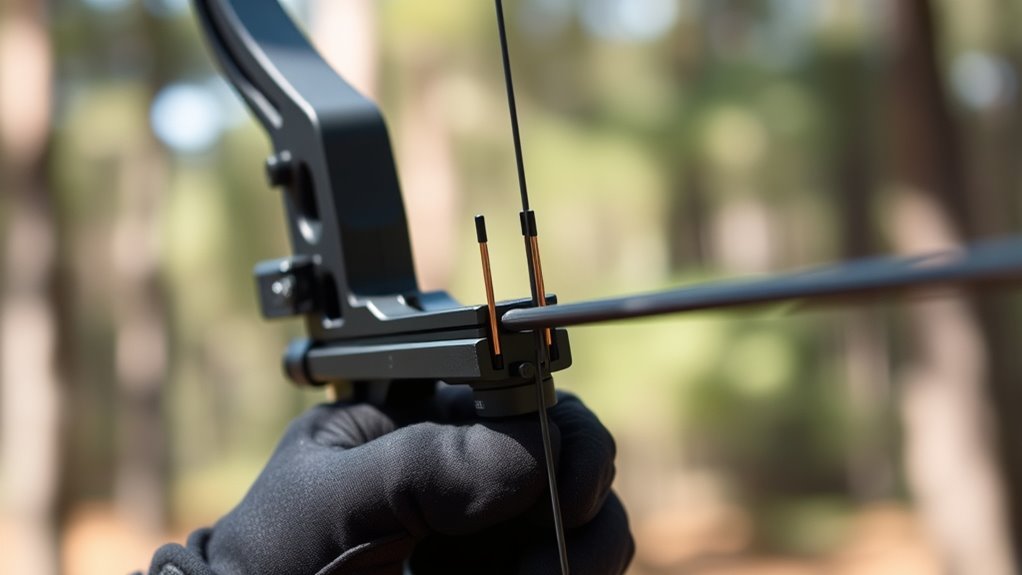
Before you attach a sight to your bow, you’ll want to make certain you pick one that fits your specific setup. First, consider the type of bow you’re using—compound, recurve, or traditional. Each requires different sight options.
Choose a sight tailored to your bow type—compound, recurve, or traditional—for the best fit and performance.
For compound bows, adjustable pin sights or single-pin scopes are common, while recurve and traditional bows often use simpler fixed or aperture sights. Next, think about your shooting style and distance. If you shoot at varying ranges, a multi-pin or adjustable sight might suit you best.
For target shooting, precision and fine adjustments are essential. Also, check the mounting compatibility with your bow’s riser—some sights need specific brackets or adapters. Don’t overlook your budget, but remember quality matters for durability and accuracy.
Finally, consider ease of use; you want a sight that’s straightforward to adjust and read under different conditions. Taking these factors into account guarantees your sight enhances your shooting, not complicates it.
Mount Your Bow Sight Securely and Level
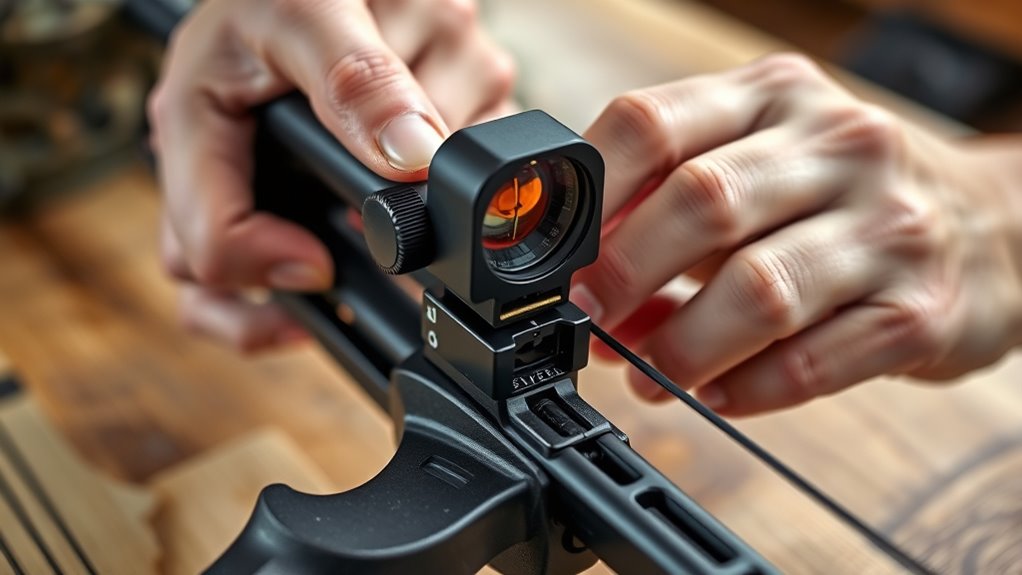
You’ll want to start by choosing the right mount that fits your bow securely. Make certain the sight is attached tightly to prevent any movement during use.
Finally, level your sight properly to ensure accurate aiming every time.
Choosing the Right Mount
Although mounting your bow sight might seem straightforward, choosing the right mount is essential to guarantee it stays secure and level during use. You’ll want to pick a mount compatible with your bow’s make and model; not all mounts fit every bow, so double-check specifications before buying.
Consider the mount’s material—aluminum mounts offer durability without adding much weight, while some composite mounts can absorb vibrations better. Also, think about adjustability; a mount with easy vertical and horizontal adjustments helps you fine-tune your sight alignment more efficiently.
Ultimately, ensure the mount provides a solid base that minimizes movement but allows for minor tweaks when needed. Picking the right mount sets the foundation for accurate shooting and a smooth sighting experience.
Ensuring Secure Attachment
Since a securely attached and level bow sight is essential for consistent accuracy, you’ll want to double-check that every screw is tightened properly without overdoing it. Start by mounting the sight onto your bow’s riser, aligning it with the chosen mounting holes. Use the appropriate screwdriver or Allen wrench to snug each screw firmly, but be careful not to strip the threads or warp the sight.
If your sight has multiple mounting points, tighten screws incrementally in a crisscross pattern to ensure even pressure. After securing all screws, give the sight a gentle wiggle to confirm it doesn’t shift or loosen. This guarantees your sight stays in place during use, providing a stable reference point for aiming every shot.
Leveling the Sight Properly
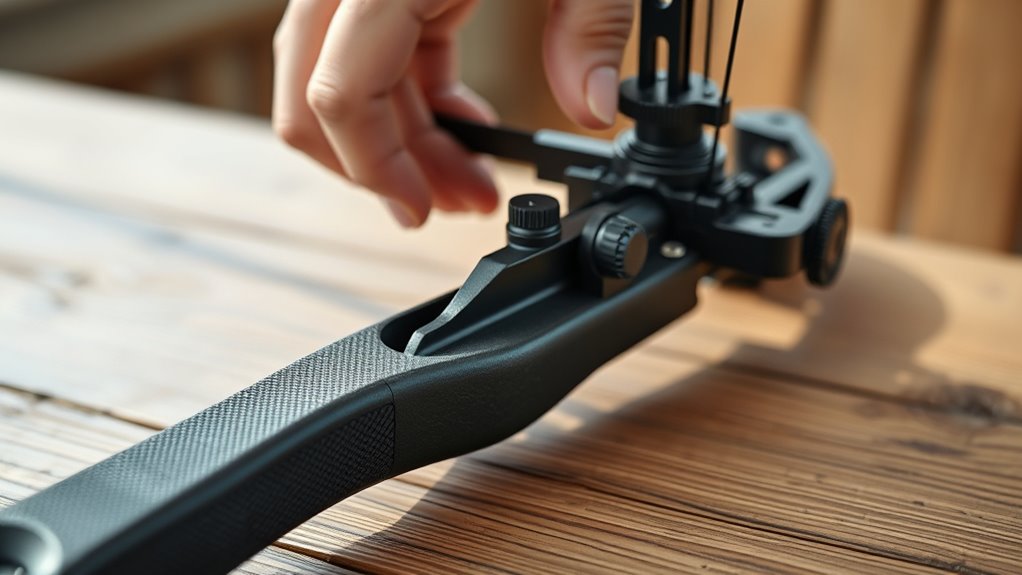
Before you start fine-tuning your aim, make sure your bow sight is perfectly level. A sight that’s even slightly tilted can throw off your accuracy. Begin by mounting your sight securely to the bow’s riser using the appropriate screws or bolts.
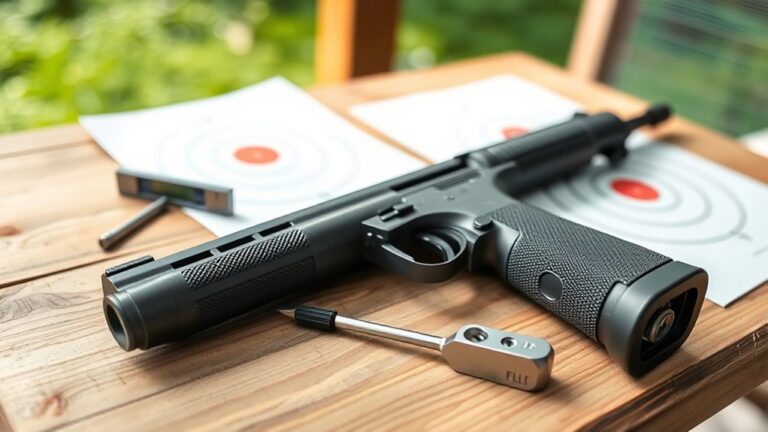
Once attached, use a small bubble level placed on the sight housing or the bow’s flat surfaces to check alignment. Adjust the sight until the bubble sits exactly between the level’s markers. If your sight has a built-in leveling feature, rely on that for easier adjustments.
Take your time here—rushing can result in frustrating missed shots later. Remember, a level sight provides a consistent reference point, ensuring your arrows fly true every time you draw.
Adjust Your Bow Sight Pins for Target Distance
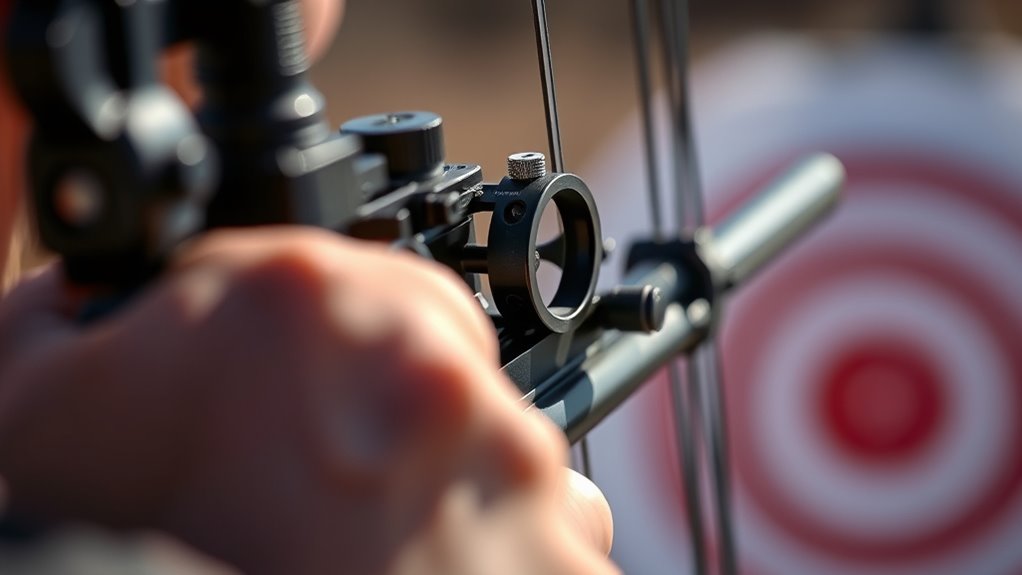
Now that your bow sight is mounted, it’s time to adjust your pins for different target distances. You’ll need to understand where each pin should be placed and calibrate them carefully. Fine-tuning these pins will help you hit your target more accurately every time.
Understanding Pin Placement
How do you know where to place your bow sight pins for different target distances? The key is understanding that each pin corresponds to a specific range. Typically, the top pin is set for your closest target distance, while the lower pins represent progressively farther distances.
You’ll want to start by choosing standard yardages—like 20, 30, 40, and 50 yards—and assign each pin accordingly. When you aim, align the pin that matches your target’s distance with the target itself. Remember, consistent shooting form helps maintain accuracy with your pin placements.
Avoid guessing; instead, practice shooting at known distances to confirm each pin’s effectiveness. This understanding allows you to quickly adjust your aim in the field without needing to recalibrate constantly.
Calibrating for Distance
Since every bow and archer is unique, you’ll need to calibrate your sight pins to confirm they match your specific shooting distances. Start by setting your bow on a rest and aiming at a target at a known distance, typically 20 yards. Shoot a group of arrows and observe where they land relative to your aiming point.
Adjust the pin up or down until your arrows consistently hit the bullseye. Once the first pin is set, move to longer distances like 30 or 40 yards and repeat the process with the other pins. Mark each pin clearly for its corresponding distance.
This step ensures that when you shoot at varying ranges, your pins provide accurate reference points, helping you hit your target consistently without guesswork.
Fine-Tuning Sight Pins
After you’ve roughly calibrated your sight pins, it’s important to fine-tune them by making small adjustments based on your actual shooting experience. Take shots at known distances and note where your arrows land relative to your aiming point. If your arrows consistently hit high, low, left, or right, adjust the corresponding sight pin slightly in that direction.
Make incremental changes—usually just a click or two at a time—and shoot again to confirm. Remember, environmental factors like wind or light can affect accuracy, so test in conditions similar to where you’ll be shooting. Over time, these small tweaks will help you dial in your pins precisely, improving your consistency and confidence at various target distances.
Keep notes to track adjustments and results for future reference.
Align Your Bow Sight for Precise Aiming
Before you start shooting, you’ll need to carefully align your bow sight to guarantee your arrows hit the target where you intend. Begin by mounting your bow on a stable rest or having someone hold it steady at full draw. Look through the sight and position the sight pin so it lines up with your target’s center.
Adjust the windage (left-right) and elevation (up-down) screws to move the sight housing until the pin perfectly matches your aiming point. Make sure your eye is consistently positioned behind the sight to avoid parallax errors. Check both the horizontal and vertical alignment by aiming at a fixed point from a known distance, like 20 yards.
Small adjustments can make a big difference, so move the sight in tiny increments. Once aligned, secure all screws tightly to prevent movement. This careful alignment ensures your aim is precise, setting the foundation for consistent accuracy before you begin practicing shots.
Practice Using Your Bow Sight to Improve Accuracy
Once your bow sight is properly aligned, the next step is to practice using it regularly to build your accuracy. Start by shooting at targets from a close distance, focusing on keeping the sight pin steady on your aiming point. Consistency is key—try to replicate the same shooting form each time.
Gradually increase your distance as you become more comfortable with your sight. Pay attention to how your sight helps you aim and adjust your stance or grip if needed. Practice in different lighting conditions to get used to how the sight performs in varied environments.
It’s also helpful to practice shooting from different angles or positions to simulate real shooting scenarios. By dedicating time to focused practice, you’ll develop muscle memory and better eye coordination, which are essential for accurate shooting. Remember, the more you practice with your bow sight, the more instinctive and precise your shots will become.
Fine-Tune Your Bow Sight for Consistent Accuracy
Although your initial sight setup gets you on target, fine-tuning your bow sight is essential for consistent accuracy. Start by shooting a group of arrows at a target from a set distance, then observe where your shots land relative to the bullseye. Adjust your sight’s windage (left/right) and elevation (up/down) screws incrementally to bring your shots closer to the center.
Make small, deliberate changes—usually one click at a time—and retest after each adjustment. Keep notes on the adjustments you make and the results you get; this helps you track what works best. Also, consider environmental factors like wind or lighting, as they may affect your point of impact and require slight recalibration.
Maintain Your Bow Sight and Fix Common Problems
Fine-tuning your bow sight improves your accuracy, but keeping it in good condition guarantees those adjustments stay reliable over time. Regularly check for loose screws or parts and tighten them to prevent shifting during use. Clean your sight with a soft cloth to remove dirt, dust, and moisture that can affect visibility and function.
If your pins become dim or hard to see, replace or adjust the fiber optics or illumination system.
Common problems include wobbling sights, misaligned pins, or fogged lenses. To fix wobbling, ensure the mounting bracket is secure and tighten any loose bolts. For misaligned pins, re-zero your sight following the tuning process.
If lenses fog up, consider using anti-fog sprays or wiping them with a microfiber cloth.
Frequently Asked Questions
Can a Bow Sight Be Used for Hunting Different Types of Game?
Yes, you can use a bow sight for hunting different types of game. It helps improve your aim at various distances, making your shots more accurate whether you’re hunting small or large animals in different environments.
Using a bow sight allows you to adjust for elevation and windage, which is crucial when targeting game at varying ranges. This adaptability enhances your chances of a clean, ethical kill.
Whether you’re in dense woods or open fields, a bow sight provides the precision needed for effective hunting. It’s a versatile tool that benefits hunters of all skill levels.
How Does Weather Affect the Performance of a Bow Sight?
Weather affects your bow sight’s performance by causing moisture, fog, or dirt to blur your view. Cold can shrink materials, misaligning the sight, while rain or humidity might cause rust or damage if it’s not weather-resistant.
These conditions can reduce accuracy and reliability, making it harder to aim precisely. Proper maintenance and using weather-resistant sights can help mitigate these issues. Always check your equipment before use in adverse weather.
Are There Any Legal Restrictions on Using Bow Sights in Competitions?
You won’t find knights jousting with bow sights, but yes, some competitions restrict or ban them to keep things fair. Always check the specific event’s rules so you don’t get disqualified or lose your chance at victory.
What Are the Best Brands for Beginner-Friendly Bow Sights?
You’ll want to check out brands like Trophy Ridge, Vortex, and Bear Archery for beginner-friendly bow sights. They’re affordable, easy to adjust, and reliable, making your learning curve much smoother and enjoyable.
Can Bow Sights Be Used Effectively With Crossbows?
Yes, you can use bow sights effectively with crossbows—about 70% of crossbow hunters prefer them for improved accuracy. Just make sure to choose a sight designed for crossbows, as traditional bow sights might not fit properly.
Using the right sight can greatly enhance your shooting precision and overall hunting experience. It’s important to consider the specific features that cater to crossbow mechanics. This ensures better alignment and consistency in your shots.
Conclusion
Just like mastering a bow sight, life’s about aiming carefully and adjusting as you go. When you choose the right sight and fine-tune it with practice, your accuracy improves—whether on the target or in your goals.
Remember, the small tweaks you make today can hit bigger marks tomorrow. So, keep your sight steady and your focus sharp; you’ll be amazed how precision in archery mirrors precision in life.
Using a sight on a bow effectively requires patience and consistent adjustment. With these simple steps, you can enhance your shooting skills and achieve better accuracy. Practice regularly, and soon your aim will be as true as your intentions.