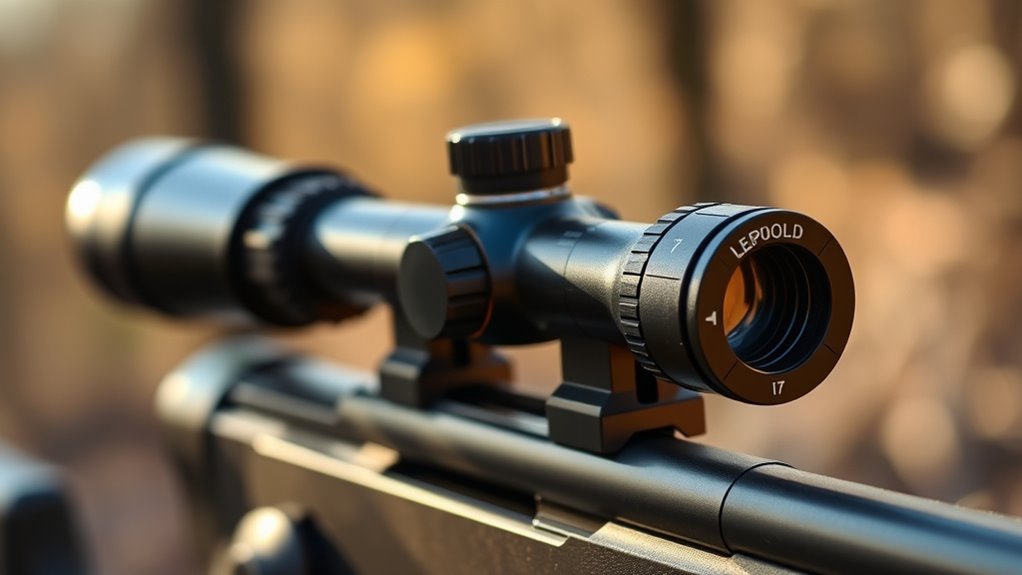
7 Steps to Sight Your Leupold CDS Scope
To sight your Leupold CDS scope accurately, begin by securing your unloaded rifle firmly and ensuring the scope is tightly mounted. Proper mounting is crucial for consistent performance and reliability.
Taking a stable shooting position helps you align the reticle precisely with your target, setting the foundation for accurate shooting.
Next, zero the scope using elevation and windage adjustments. This initial zeroing is essential before progressing to test shot groups for fine-tuning your aim.
Use the CDS turret to verify zero at various distances, making adjustments as needed to maintain precision.
Finally, maintain your scope by regularly cleaning the lenses and checking all screws for tightness.
Following these steps sets you up for precise, reliable shots—and there’s more to master for perfect accuracy.
Key Takeaways
- Secure the rifle in a stable rest and ensure the scope is mounted and tightened properly.
- Adjust the eyepiece focus and center the reticle over the bullseye before zeroing.
- Fire a 3-5 shot group, then adjust elevation and windage turrets incrementally for accurate impact alignment.
- Use the CDS turret to verify zero at various distances and fine-tune as needed.
- Regularly check and maintain zero by firing test shots after impacts or extended use.
Prepare Your Rifle and Leupold CDS Scope for Sighting
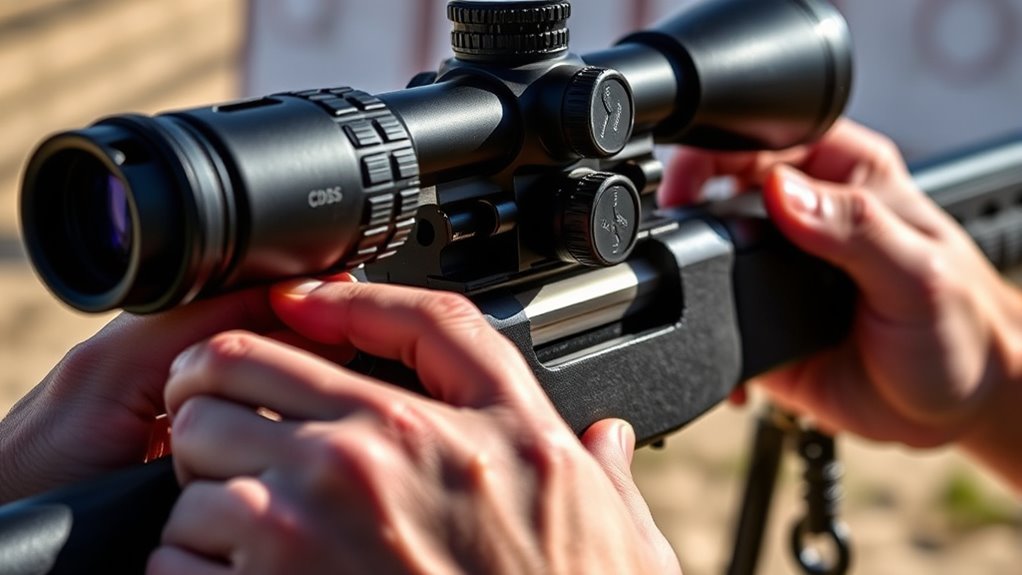
Before you begin sighting your Leupold CDS scope, make sure your rifle is unloaded and securely mounted in a stable rest or vice. This guarantees safety and prevents movement during the sighting process.
Next, check that your scope is properly mounted and tightened on the rifle. Loose mounts can cause inconsistent accuracy, so use a torque wrench to apply the recommended pressure on the mounting screws.
Ensure your scope is securely mounted and tightened using a torque wrench for consistent accuracy.
Inspect the scope lenses for any dirt or smudges and clean them with a lens cloth if necessary. Clear optics are essential for precise sighting. Adjust the eyepiece’s focus to get a crisp reticle image, so you won’t struggle with blurry visuals later.
Finally, set the scope’s elevation and windage turrets to their mid-range settings. This gives you enough adjustment room in all directions and makes it easier to zero your rifle accurately during the sighting process.
Once prepared, you’re ready to move on confidently.
Secure a Stable Shooting Position for Leupold CDS Sighting
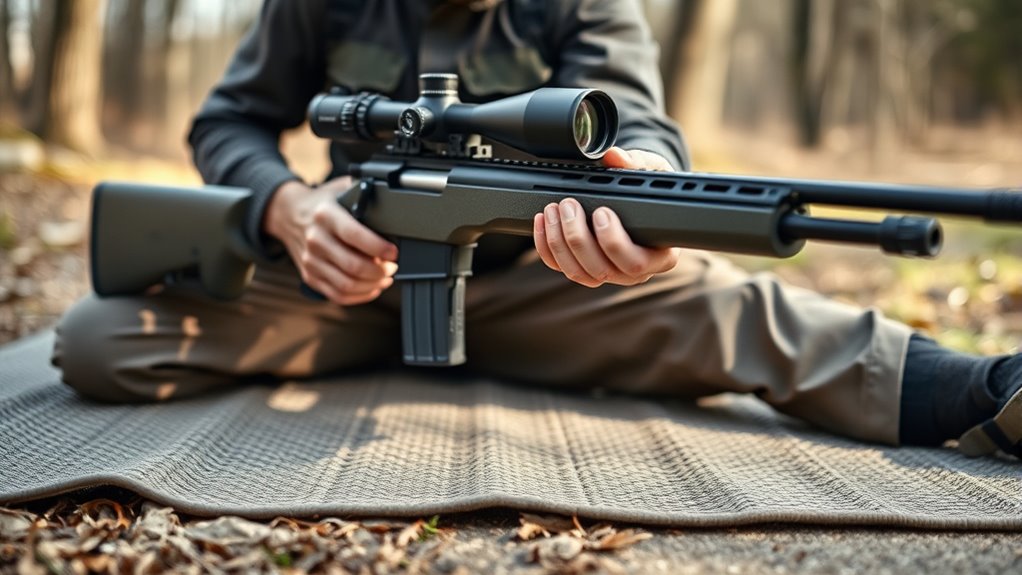
To get accurate shots, you’ll want to pick a shooting spot that’s steady and free from distractions. Make sure you’re comfortable and your rifle is well-supported to minimize movement.
A solid position helps you make the most of your Leupold CDS scope’s precision.
Choosing Your Shooting Spot
Where you set up your shooting spot can make all the difference when sighting your Leupold CDS scope. Choose a location that offers a clear, unobstructed view of your target with consistent lighting. Avoid areas with heavy shadows or glare, as they can interfere with accurate sight adjustments.
Look for a spot with minimal wind to reduce shot deviation. Also, consider your shooting distance—pick a range that matches your typical hunting or shooting scenarios for more relevant zeroing. Make sure the terrain is level and allows you to align your rifle comfortably with your line of sight.
Taking the time to select a *favorable* shooting spot ensures you get the most precise results when sighting your scope, setting you up for success in the field.
Ensuring Stability and Comfort
How can you guarantee your shots are consistent when sighting your Leupold CDS scope? It all starts with ensuring stability and comfort in your shooting position. Without a solid foundation, your adjustments won’t translate into reliable accuracy.
Follow these steps to secure a stable shooting position:
- Choose a firm surface: Use a shooting bench or stable ground to minimize movement.
- Use a rest or bipod: Support your rifle to reduce wobble and fatigue.
- Set a comfortable posture: Align your body naturally to avoid tension and maintain focus.
- Control your breathing: Take slow, steady breaths to keep the rifle steady during sighting.
Center Your Reticle on the Target
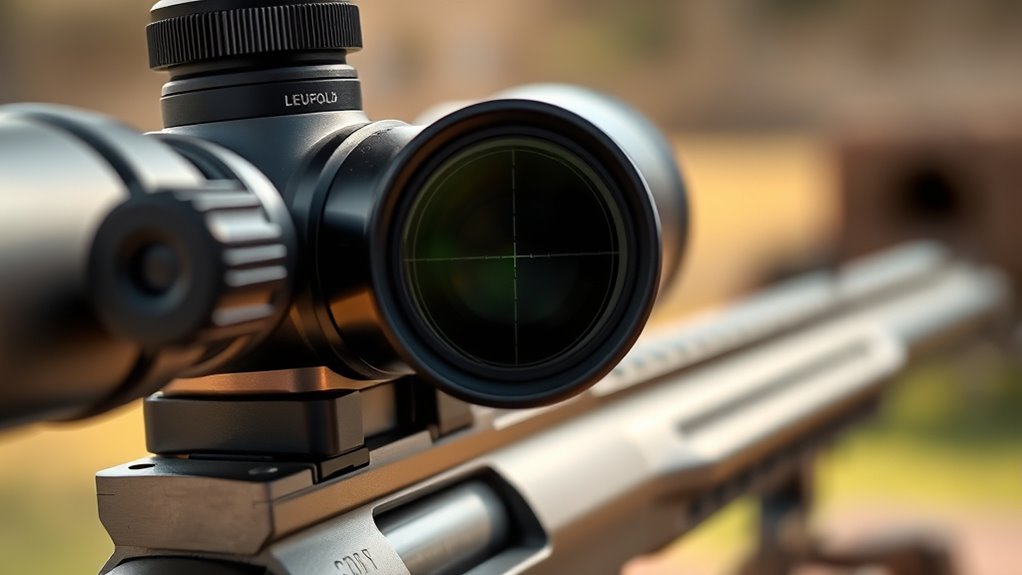
Although you’ve already adjusted your scope, it’s essential to make certain your reticle is perfectly centered on the target before moving forward. To do this, look through your Leupold CDS scope and align the reticle so that its crosshairs precisely overlay the bullseye or your chosen aiming point. Take your time—any slight misalignment can affect accuracy downrange.
Keep both eyes open if you can; this helps maintain better situational awareness and reduces eye strain. Confirm that your head and eye position are consistent each time you check the reticle alignment to prevent parallax errors. If the reticle isn’t centered, gently adjust your scope mount or reposition your rifle until it is.
This careful centering ensures that when you begin zeroing your scope using elevation and windage, your starting point is as accurate as possible, giving you a reliable foundation for precise shot placement.
Zero Your Scope Using Elevation and Windage
Once your reticle is perfectly centered on the target, you can begin zeroing your scope by adjusting the elevation and windage settings. These controls help you align your point of aim with the bullet’s point of impact.
Here’s how to zero your scope:
- Adjust Elevation: Turn the elevation turret to move the reticle up or down until your shots hit at the desired vertical point.
- Adjust Windage: Use the windage turret to shift the reticle left or right to correct horizontal deviation.
- Fire a Group: Shoot a 3-5 round group to see where your bullets cluster relative to the reticle.
- Fine-Tune: Repeat adjustments as needed, moving the turrets in small increments to bring the group directly onto the aiming point.
Check Your Zero at Different Distances Using the CDS Turret
Now that you’ve zeroed your scope, it’s important to check your zero at different distances using the CDS turret. This turret lets you quickly adjust for elevation without guessing, so you can fine-tune your aim as range changes.
Make sure to verify your accuracy across various distances to get the most out of your scope.
Understanding CDS Turret Function
To get the most out of your Leupold CDS turret, you’ll need to understand how it lets you check your zero at various distances without guesswork. The CDS turret is designed with calibrated markings that correspond to different yardages, allowing you to quickly verify your zero without adjusting elevation settings blindly.
Here’s how it works:
- The turret’s dial has preset increments linked to specific distances.
- You rotate the turret to the desired yardage marking.
- The scope’s reticle automatically compensates for bullet drop at that distance.
- You can confirm if your point of impact matches the intended target range without additional calculations.
This system simplifies distance verification, ensuring your scope remains accurate over multiple ranges.
Adjusting Zero At Distance
How do you guarantee your Leupold CDS scope stays accurately zeroed at various distances? Start by confirming your initial zero at your chosen baseline distance, like 100 yards. Then, using the CDS turret, adjust the elevation to correspond with your target distance.
The turret is calibrated to make these changes straightforward—simply rotate it to the distance marking on the dial. After adjusting, take a few shots to verify your point of impact matches your aim. If it’s off, fine-tune the turret until your shots consistently hit the mark.
Verifying Accuracy Across Ranges
Although you’ve set your initial zero using the CDS turret, it’s vital to verify your scope’s accuracy at various distances to guarantee consistent performance.
Here’s how you can check your zero across ranges:
- Select Multiple Distances: Choose key distances that represent your typical shooting scenarios, such as 100, 200, 300, and 400 yards.
- Take Controlled Shots: At each distance, fire a group of shots aiming at the same point of aim to confirm consistency.
- Observe Point of Impact: Note any deviations from your expected impact point and compare them with your CDS turret settings.
- Make Adjustments if Needed: Use the CDS turret to fine-tune your zero for any discrepancies, ensuring your scope’s ballistic profile matches real-world results.
This process guarantees your scope performs reliably over varying distances.
Fine-Tune Your Scope Based on Shooting Group Patterns
Once you’ve gathered a few shooting groups on your target, you can start making precise adjustments to your Leupold CDS scope. Look closely at where your shots cluster compared to the bullseye. If your groups consistently land to one side, adjust windage; if they’re high or low, tweak elevation.
Small, incremental changes help you zero in without overcorrecting.
Use this guide to interpret your group patterns and the adjustments needed:
| Group Pattern | Adjustment Direction | Suggested Change |
|---|---|---|
| Left of bullseye | Move reticle right | 1 click right |
| Right of bullseye | Move reticle left | 1 click left |
| High on target | Move reticle down | 1 click down |
| Low on target | Move reticle up | 1 click up |
Repeat this process until your shots group tightly around the bullseye, ensuring your scope is finely tuned for accuracy.
Maintain and Recheck Your Leupold CDS Scope
To keep your Leupold CDS scope performing at its best, you’ll need to regularly maintain and recheck it. This ensures consistent accuracy and extends the life of your scope. Start by following these key steps:
- Clean the lenses carefully using a microfiber cloth and lens cleaner to avoid scratches and maintain clarity.
- Check mounting screws and rings to confirm they’re tight and secure, preventing any shift in your zero.
- Inspect the elevation and windage adjustments to ensure they move smoothly without resistance or looseness.
- Confirm your zero by firing a few test shots after any physical impact or after extended use, adjusting if necessary.
Routine upkeep helps you avoid surprises in the field and keeps your scope calibrated. By maintaining your Leupold CDS scope this way, you’ll enjoy reliable performance and precision whenever you need it.
Frequently Asked Questions
What Is the Warranty Period for Leupold CDS Scopes?
Leupold CDS scopes come with a lifetime warranty, so you don’t have to worry about defects or damage. They stand behind their products, ensuring your scope is covered for as long as you own it, no hassle.
Can Leupold CDS Scopes Be Used in Extreme Weather Conditions?
Yes, you can use Leupold CDS scopes in extreme weather conditions. They’re built tough with waterproof, fog-proof, and shockproof features, so you don’t have to worry about performance whether it’s rain, snow, or intense heat.
These scopes are designed to withstand harsh environments, ensuring reliability no matter what weather you face. The durable construction keeps them functioning optimally in challenging outdoor situations.
Whether you’re hunting in a downpour or navigating freezing temperatures, Leupold CDS scopes maintain their precision and clarity. This makes them a dependable choice for extreme weather use.
How Do I Clean the Lenses of My Leupold CDS Scope?
Did you know 90% of lens damage comes from improper cleaning? To clean your Leupold CDS scope lenses, gently blow off dust, use a soft microfiber cloth with lens cleaner, and avoid harsh chemicals to keep them crystal clear.
Always handle the lenses with care to prevent scratches and damage. Regular maintenance ensures optimal performance and longevity.
Are There Any Recommended Accessories for Leupold CDS Scopes?
You’ll want lens covers, a scope level, and a sunshade to protect and enhance your Leupold CDS scope.
Also, consider a quality cleaning kit and a scope mount or rings designed specifically for your rifle.
What Is the Difference Between Leupold CDS and Standard Scopes?
Think of your standard scope as a steady compass, while the Leupold CDS is like a dynamic map—it adjusts for distance and bullet drop, so you’re not just aiming, but predicting your shot’s journey with precision.
Conclusion
Now that you’ve walked through these steps, sighting your Leupold CDS scope should feel like second nature. Remember, patience is your best friend—each adjustment brings you closer to that perfect shot. Like tuning a musical instrument, small tweaks make all the difference in harmony and precision.
Keep practicing, maintain your scope, and you’ll consistently hit the mark with confidence and ease. Your Leupold CDS scope is ready to perform—now it’s your turn to shine. With proper sighting, your Leupold CDS will enhance your accuracy and shooting experience every time.