How to Sight a Pellet Gun in 7 Easy Steps
To sight your pellet gun accurately, follow these 7 easy steps to improve your shooting precision and consistency. Properly sighting your pellet gun is essential for hitting targets accurately and boosting your confidence.
Start by prepping your gun and safety gear, ensuring everything is clean and secure before you begin.
Choose a proper target and set a shooting distance of 10–20 yards.
Align your sights carefully, then fire a group of test shots to see where pellets hit the target.
Adjust your sights based on the grouping, repeating tests until shots are tight and consistent.
Finally, fine-tune your pellet gun sights for different distances and weather conditions.
Stick with this method, and you’ll quickly improve your accuracy and confidence with every shot.
Key Takeaways
- Wear proper eye and hearing protection, and ensure the pellet gun and sights are clean and securely mounted before starting.
- Choose suitable targets and set up at 10-20 yards with a safe, clear backstop for initial sighting.
- Fire 3-5 controlled shots while maintaining a steady stance, then observe and record shot groupings on the target.
- Make small incremental sight adjustments based on shot impacts, testing repeatedly until pellets group tightly at the center.
- Fine-tune sights for various distances and environmental conditions, keeping detailed records for ongoing calibration and accuracy.
Prepare Your Pellet Gun and Safety Gear
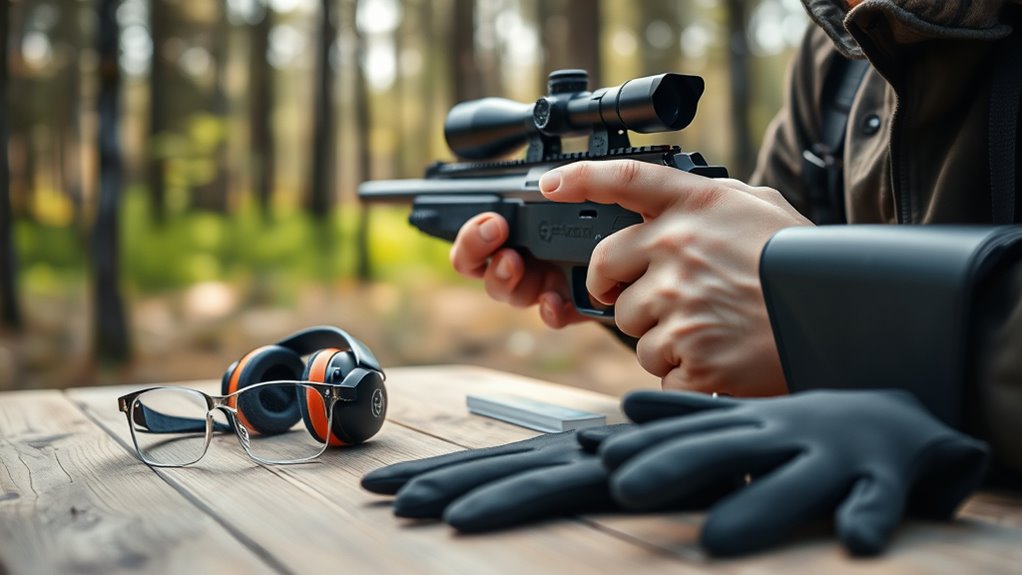
Before you begin sighting your pellet gun, make sure you have all the necessary safety gear ready, including eye protection and hearing protection if needed. Safety should be your top priority, so don’t skip this step.
Always prioritize safety by wearing proper eye and hearing protection before sighting your pellet gun.
Next, check your pellet gun to ensure it’s clean and in good working order. Remove any dirt or debris that might affect accuracy. Confirm the barrel is free from obstructions, and check that the sights or scope are securely mounted.
If you’re using a scope, make sure the batteries are fresh, and the lenses are clean. Also, have the right pellets on hand; inconsistent pellet quality can impact your sighting process. Before you start, familiarize yourself with your gun’s safety mechanisms so you can handle it confidently.
Finally, set up your shooting area in a safe, controlled environment where you won’t be disturbed or cause harm. Preparing properly *guarantees* the foundation for accurate sighting and safe shooting.
Choose the Right Target and Shooting Distance
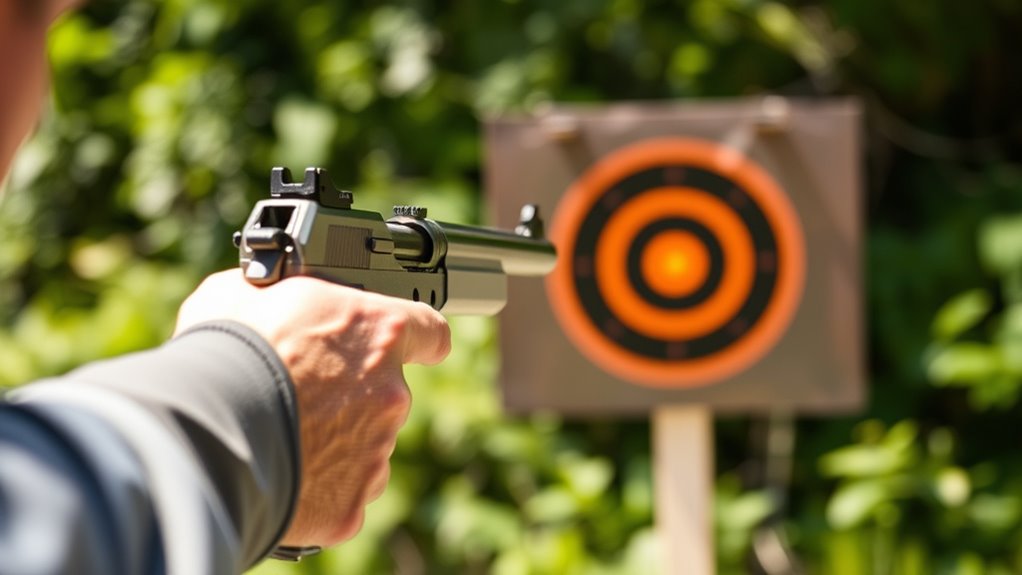
You’ll want to pick a target that’s durable enough to stop pellets without damage or ricochet. Next, choose a shooting distance that matches your gun’s power and accuracy for consistent results.
Always consider safety and make sure your target is clearly visible and in a secure area.
Selecting Appropriate Target Material
Although pellet guns are less powerful than traditional firearms, choosing the right target material is essential to guarantee safety and accurate sighting. You want a target that clearly shows pellet hits, minimizes ricochets, and withstands repeated shots. Paper targets work well for precision but don’t absorb pellets, requiring a backstop.
Foam or rubber targets reduce ricochets and last longer. Avoid metal targets, as pellets can ricochet dangerously.
| Target Material | Benefits |
|---|---|
| Paper | Clear impact visibility |
| Foam | Absorbs pellets, reusable |
| Rubber | Durable, minimizes ricochets |
| Cardboard | Affordable, decent visibility |
| Metal | Not recommended, ricochets |
Picking the right material helps you sight your pellet gun effectively and safely.
Determining Optimal Shooting Range
Choosing the right target material sets the stage for figuring out your ideal shooting range. You want a target that clearly shows pellet impact without damaging your gun or pellets. Once you’ve got that sorted, consider your pellet gun’s power and accuracy.
For most airguns, 10 to 20 yards is a practical range to sight in accurately. Closer distances help you spot initial grouping, while slightly longer distances test your gun’s precision better. Avoid shooting too far initially, as wind and pellet drop can mislead your adjustments.
Mark your target clearly and keep your shooting distance consistent during sighting. By choosing an appropriate range, you’ll find it easier to make precise adjustments and improve your pellet gun’s performance.
Considering Safety and Visibility
When sighting in your pellet gun, it’s important to pick a target and shooting distance that guarantee both safety and clear visibility. Choose a target placed against a solid backstop, like a thick wooden board or a pellet trap, to safely stop pellets and prevent accidents. Make certain the area behind and around your target is free of people, pets, and fragile items.
Select a shooting distance that allows you to clearly see the target’s details without straining your eyes—usually between 10 to 20 yards for most pellet guns. Avoid shooting at reflective or moving targets, as they can cause ricochets or missed shots. Prioritizing safety and visibility ensures a more effective sighting experience and protects everyone involved.
Set Your Pellet Gun’s Sights for Initial Alignment
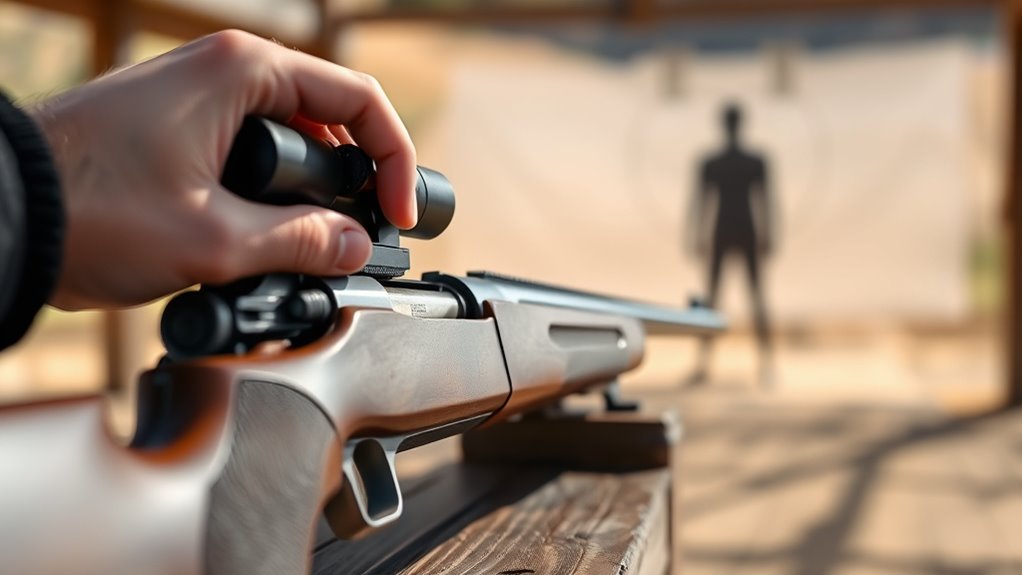
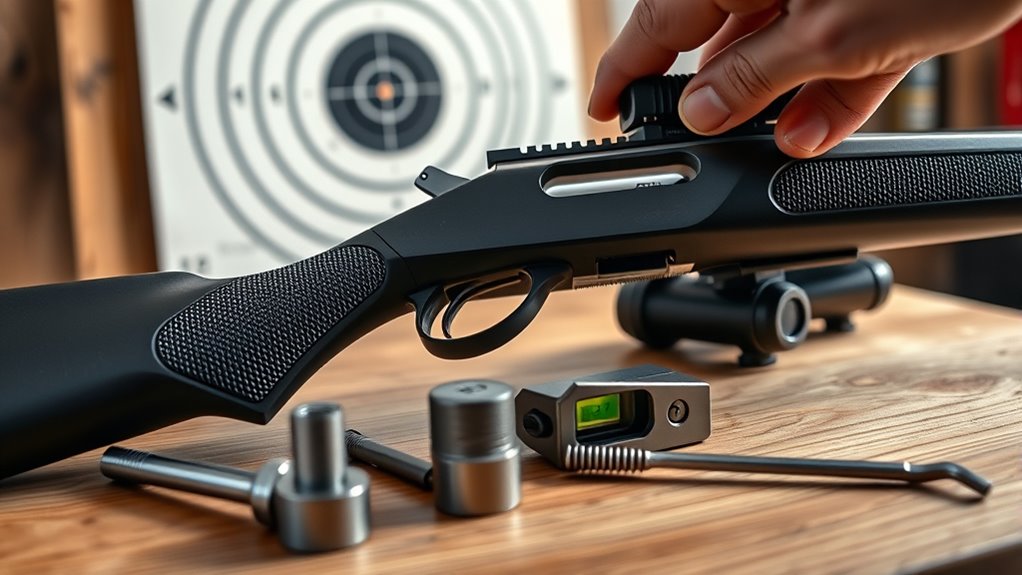
Now it’s time to set your pellet gun’s sights for initial alignment. Start by choosing the proper sight type that suits your shooting style and preferences.
Don’t forget to adjust for your dominant eye to guarantee accurate aiming.
Choose Proper Sight Type
Since your pellet gun’s accuracy depends largely on its sights, selecting the right type is vital for initial alignment. You’ll want to choose between open sights, peep sights, or optical sights based on your shooting style and conditions. Open sights are straightforward and durable, ideal for beginners or casual shooting.
Peep sights offer better precision by narrowing your focus, making them suitable if you’re aiming for tighter groupings. Optical sights, like scopes or red dots, provide magnification and clarity, perfect for longer distances or hunting. Consider your typical shooting range and environment when deciding.
Also, verify the sight you pick is compatible with your pellet gun’s mounting system. Picking the proper sight type sets a solid foundation for quick and effective sighting adjustments later.
Adjust For Eye Dominance
Choosing the right sight is just the start; to get your pellet gun accurately aligned, you’ll want to modify for your dominant eye. First, identify which eye you naturally use to aim—this is your dominant eye. You can do this by extending your arms, forming a small triangle with your hands, and focusing on a distant object.
Close one eye at a time; the eye that keeps the object centered is your dominant one. Once you know this, mount or adjust the sights so they align with your dominant eye’s line of sight. This ensures you’re looking directly through the sights without awkward head positioning, improving accuracy.
Proper eye dominance adjustment sets a solid foundation before fine-tuning windage or elevation.
Fire a Group of Test Shots With Your Pellet Gun to Check Aim
Before making any adjustments, you’ll want to fire a group of test shots to see where your pellets are actually landing. Set up a target at your preferred distance, usually around 10 to 20 yards for initial sighting. Take your time with each shot, maintaining a proper stance and steady breathing to guarantee consistency.
Fire test shots at 10 to 20 yards with steady breathing to observe where your pellets land before adjusting sights.
Aim carefully at the same point every time. After firing 3 to 5 shots, examine the grouping on your target. The pattern shows you where your gun’s sights are currently aligned relative to your point of aim.
Keep in mind the center of your group, not just one pellet. This gives a clearer indication of where the gun is naturally shooting. Recording the results and distances helps track changes as you continue sighting.
This step is vital to understanding how much adjustment your sights may need, but don’t make any changes just yet. Focus on getting a reliable baseline first.
Adjust Your Pellet Gun’s Sights Based on Test Shot Grouping
Once you’ve identified where your pellet group is landing, you can begin adjusting your gun’s sights to bring those shots closer to your intended point of aim. If your pellets are hitting low, raise the rear sight or lower the front sight slightly. Conversely, if shots are high, lower the rear sight or raise the front sight.
For shots landing left, move the rear sight to the right or the front sight to the left, and do the opposite if shots are right of target. Make small adjustments—usually a fraction of a click or a slight turn—then test again. Avoid overcorrecting, as even tiny changes can notably shift your impact point.
Keep track of your adjustments so you can revert if needed. With patience and precise tweaks, you’ll bring your shots onto target, ensuring your pellet gun shoots accurately where you want it to hit.
Repeat Testing and Adjusting Until Shots Are Consistent
After making initial adjustments to your sights, you’ll want to test your shots repeatedly to confirm they’re landing where you expect. Consistency is key—if your pellets aren’t grouping tightly or keep drifting, make small tweaks to your sights and test again. Each adjustment should be minor; large changes can throw off your aim and make it harder to pinpoint the problem.
Pay attention to how your shots cluster and note any patterns, like shots consistently hitting high or to one side. This helps you understand which direction to adjust your sights. Keep testing and adjusting until your shots form a tight, predictable group close to your target’s center.
Don’t rush this process; it might take several rounds to dial in precision. Once you achieve consistent grouping, you’ll have a solid baseline for reliable shooting. This repeated testing ensures your pellet gun is accurately sighted for dependable performance.
Fine-Tune Your Pellet Gun Sights for Various Distances and Weather
Although your pellet gun may be accurately sighted at a single distance, you’ll need to fine-tune your sights to maintain precision across various ranges and changing weather conditions. Start by testing your shots at multiple distances—commonly 10, 20, and 30 yards—and note how your point of impact shifts. Adjust your sights accordingly, raising or lowering the front sight or moving the rear sight left or right to compensate for bullet drop and drift.
Weather plays an essential role too. Wind can push pellets off course, so practice in different wind conditions to understand its effect. Rain and humidity may slightly alter pellet velocity, so be prepared to tweak your sights or your hold.
Keep records of adjustments for each scenario, which will save time in the field. By consistently fine-tuning your sights with distance and weather in mind, you’ll improve accuracy and confidence with every shot.
Frequently Asked Questions
What Types of Pellets Work Best for Different Pellet Guns?
You’ll want wadcutter pellets for target shooting, domed pellets for hunting because of their accuracy and penetration, and pointed pellets for small game.
Match the pellet weight and shape to your gun’s power for best results.
How Often Should I Clean My Pellet Gun for Optimal Performance?
You should clean your pellet gun after every 500 shots or whenever you notice performance drops. Like a well-oiled machine, regular cleaning keeps it accurate and reliable, so don’t let dirt cloud your aim or your fun.
Can Pellet Gun Sights Be Replaced With Scopes?
Yes, you can replace pellet gun sights with scopes. Scopes often improve accuracy and target visibility, especially at longer distances.
Just make sure the scope is compatible with your pellet gun and properly mounted for the best results.
What Maintenance Tips Extend the Life of Pellet Gun Sights?
You’ll want to keep your pellet gun sights clean and dry, check alignment regularly, tighten screws as needed. Avoid harsh impacts, and store the gun in a protective case to prevent damage and rust. This will extend sight life effectively.
Are There Legal Restrictions on Pellet Gun Usage in My Area?
You’ll find that over 60% of U.S. states have some legal restrictions on pellet gun usage, like age limits or designated shooting areas.
Conclusion
Now that you know how to sight your pellet gun, you can prepare your gear confidently, choose your target wisely, and set your sights precisely.
You’ll fire test shots carefully, adjust your aim patiently, and repeat the process consistently.
You’ll fine-tune for distance thoughtfully and adapt to weather skillfully.
By following these steps to sight a pellet gun, you’ll shoot more accurately, enjoy your practice more fully, and hit your mark more often. Mastering how to sight a pellet gun is key to improving your shooting skills and achieving better results every time.