How Does a Telescopic Sight Work?
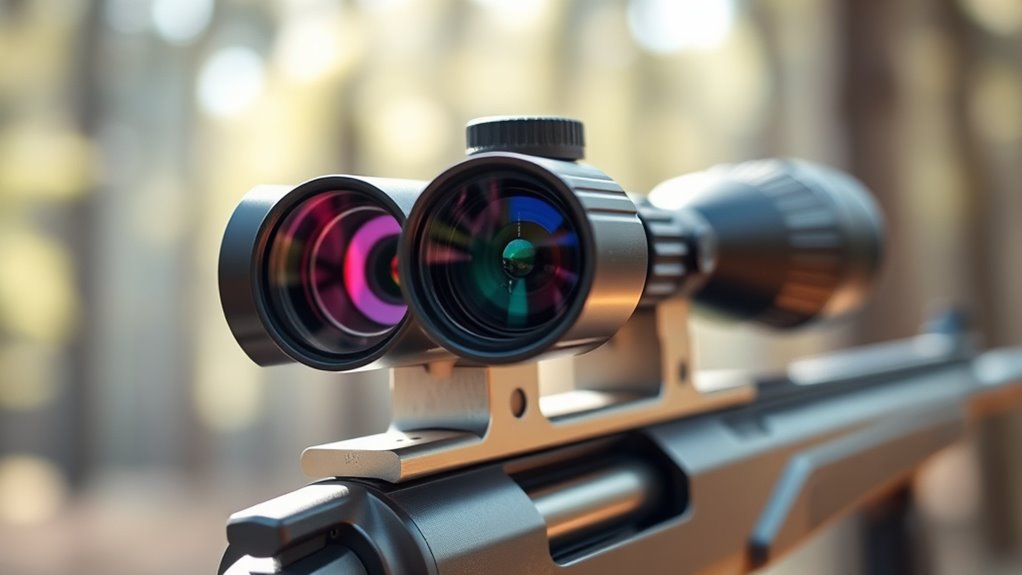
A telescopic sight works by using lenses to gather and magnify distant targets, making them easier to see and aim at precisely. These optical devices enhance accuracy by providing a clear, magnified view of the target.
Key features include adjustable turrets for elevation and windage, which allow fine-tuning of your shot alignment.
You align your shot using a reticle, a crucial aiming point inside the scope. Proper zeroing guarantees your shots hit where you want, improving shooting precision significantly.
The scope also reduces eye strain with clear optics and good light transmission for brightness.
If you want to understand scope features and adjustments better, keep exploring the details. Learning how to use these elements effectively can enhance your shooting experience.
Key Takeaways
- A telescopic sight magnifies distant targets using lenses and a reticle for precise aiming.
- Light enters through the objective lens, is focused and corrected by internal lenses, then magnified by the eyepiece.
- Adjustable windage and elevation turrets align the reticle with the bullet’s impact point for accuracy.
- Proper parallax adjustment and eye positioning prevent aim shifts and ensure the reticle matches the target.
- High-quality lens coatings improve light transmission, enhancing brightness and clarity in various lighting conditions.
What Is a Telescopic Sight and How It Improves Accuracy
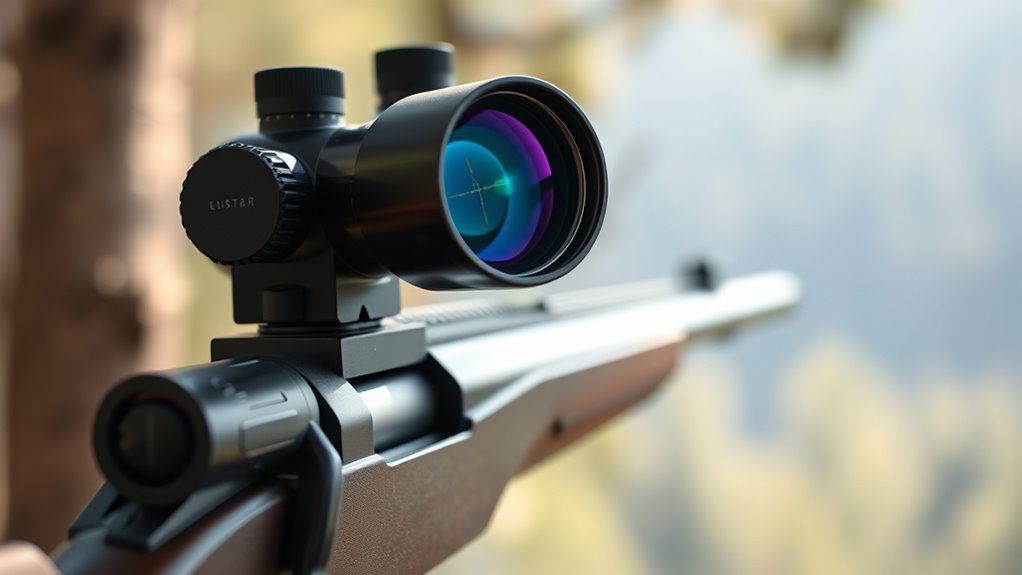
Although you might be familiar with basic iron sights, a telescopic sight offers a notable upgrade by magnifying your target, making it easier to aim precisely. Unlike iron sights, which require aligning front and rear posts, a telescopic sight uses lenses and a reticle to provide a clear, magnified view. This means you don’t have to strain your eyes to focus on distant objects, improving your accuracy considerably.
The design of a telescopic sight allows you to see finer details at longer distances, helping you place your shots more accurately. It also reduces the chance of misalignment because you look through a single lens rather than lining up multiple parts. Additionally, many telescopic sights have adjustable features like windage and elevation, letting you fine-tune your aim for various conditions.
How Telescopic Sight Lenses Magnify Your Target
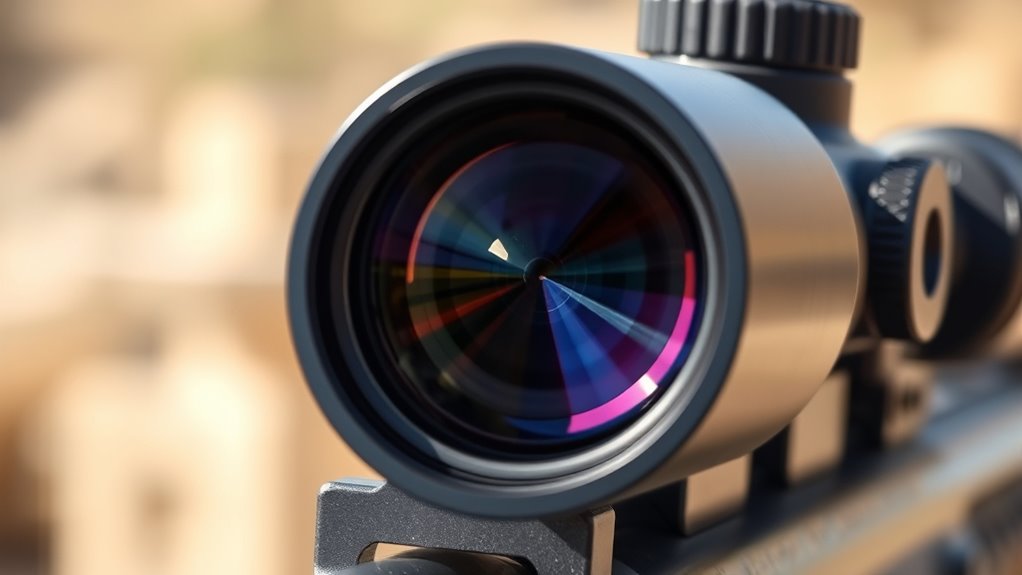
When you look through a telescopic sight, the lenses work together to magnify your target, making distant objects appear closer and clearer. Inside the scope, the objective lens gathers light from the target, focusing it to create a sharp image. This image then passes through the erector system, which flips it right-side up and adjusts its position.
Finally, the eyepiece lens magnifies this corrected image, allowing you to see fine details that would be hard to spot with the naked eye. The size and shape of these lenses affect how much light enters and how clear the image appears. High-quality glass and coatings reduce glare and enhance brightness, so your view stays sharp even in low light.
Understanding Magnification Levels and Picking the Right One
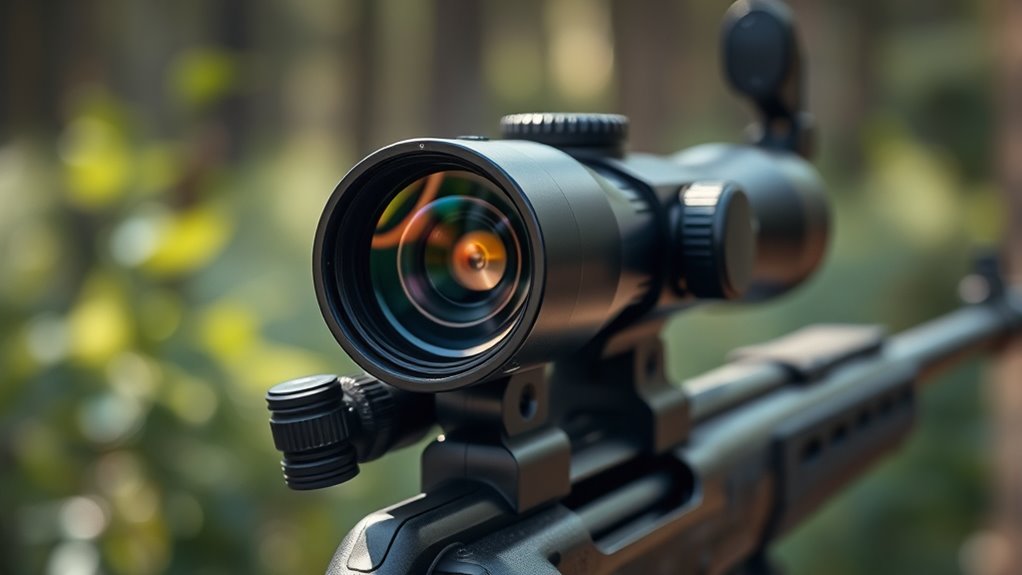
When choosing a telescopic sight, you’ll need to understand the different types of magnification available and how each affects what you see. Picking the right power depends on your specific needs, like the distance and detail you want to observe.
Keep in mind that higher magnification can impact image clarity, so finding the right balance is key.
Types Of Magnification
Since choosing the right magnification level can make or break your shooting experience, it’s important to understand the different types available. There are fixed magnification scopes, offering a single, unchanging power—ideal if you want simplicity and sharp image quality.
Then, you have variable magnification scopes, which let you adjust power within a set range, giving you flexibility for different shooting distances. Some scopes offer low power (like 1-4x) for close-range targets, while others provide high power (such as 10x or more) for long-distance precision.
Choosing Appropriate Power
How do you decide on the right magnification power for your scope? It depends on what you’re aiming for and where you’ll be shooting. Higher magnifications bring distant targets closer, but they also narrow your field of view.
Lower powers give a wider view, making it easier to track moving targets.
Consider these factors when choosing magnification:
- Target Distance: Closer targets need less magnification; long-range shots benefit from higher power.
- Shooting Environment: Dense woods or close quarters favor lower magnification, while open fields may require more.
- Movement: If your target moves fast, a lower magnification helps you keep it in sight.
Picking the right power balances zoom with usability for your specific needs.
Impact On Image Clarity
Choosing the right magnification power isn’t just about bringing your target closer; it also affects how clear and detailed the image appears through your scope. Higher magnification can make distant objects seem larger but often reduces brightness and sharpness, especially in low-light conditions.
On the other hand, lower magnification provides a wider field of view and better image clarity, making it easier to track moving targets. You’ll want to balance magnification with image quality based on your shooting needs.
For example, close to mid-range shooting benefits from lower power for clarity, while long-range shots may require higher magnification despite slight image degradation. Understanding this trade-off helps you pick a scope that delivers both sharpness and the right zoom level for your specific use.
The Role of the Reticle in Aiming Precision
Although the reticle might seem like a simple feature inside a telescopic sight, it plays an essential role in ensuring your aiming is accurate and consistent. The reticle is the pattern or crosshair you see when you look through the scope, guiding you to align your shot precisely. Without it, judging where your bullet will land would be guesswork.
The reticle may seem simple, but it’s crucial for precise and consistent aiming through your scope.
Here’s how the reticle sharpens your aim:
- Centering Your Target – The crosshairs give you a clear focal point, so you can place your shot exactly where you want it.
- Compensating for Distance – Some reticles have markings to help you adjust for bullet drop or wind drift at various ranges.
- Enhancing Focus – The reticle anchors your eye to a specific spot, keeping your focus steady even under pressure.
In short, the reticle is your primary tool for accuracy in any shooting scenario.
How to Adjust Telescopic Sight Focus for Clarity
To get a clear view through your telescopic sight, you’ll need to adjust the eyepiece properly. Correcting parallax error guarantees your target and reticle stay aligned at different distances.
You’ll also want to fine-tune the reticle sharpness for the best aiming precision.
Eyepiece Adjustment Basics
When you look through a telescopic sight, the eyepiece adjustment lets you fine-tune the focus so the image appears sharp and clear. This is vital because your eye’s natural focus varies, and the eyepiece guarantees the reticle and target align perfectly for your vision.
Here’s how to adjust it:
- Look through the scope at a blank, bright background. This helps you focus on the reticle without distractions.
- Rotate the eyepiece adjustment ring slowly. Turn it until the reticle edges are crisp and not blurry.
- Lock the eyepiece in place if your scope allows. This prevents accidental changes during use.
Mastering this basic step ensures you see your target clearly every time you aim.
Parallax Error Correction
Since even a slight misalignment can blur your target or shift the reticle, correcting parallax error is essential for clear and accurate aiming. You adjust the parallax by focusing the adjustable objective or side focus until the target and reticle appear on the same plane.
This eliminates the apparent movement of the reticle when you shift your eye.
| Distance to Target | Parallax Setting | Focus Adjustment |
|---|---|---|
| 100 yards | 100 yards | Turn focus ring |
| 200 yards | 200 yards | Fine-tune focus |
| Infinity | ∞ (infinity) | Lock focus point |
Reticle Sharpness Tuning
Although parallax correction aligns your target and reticle, you still need to fine-tune the reticle sharpness for the clearest image. This step guarantees the crosshairs don’t appear blurry or doubled, which can throw off your aim. Here’s how to do it:
- Locate the ocular focus ring at the eyepiece of your scope. It’s designed to adjust the reticle’s clarity independently from the target image.
- Look through the scope at a plain background or a distant object, then slowly rotate the focus ring until the reticle appears crisp and well-defined.
- Confirm the sharpness by switching between the background and reticle; the reticle should remain clear regardless of the background.
How to Zero Your Telescopic Sight for Accurate Shots
Before you can confidently take accurate shots, you need to zero your telescopic sight to align the reticle with your point of impact. Start by setting up a stable shooting position at a known distance, typically 25 or 100 yards. Use a target with a clear center point.
Fire a group of three to five shots, then observe where they hit relative to the reticle. Adjust the windage (left/right) and elevation (up/down) turrets on your scope to move the reticle toward the group’s center. Repeat this process until your shots consistently hit the bullseye.
Make sure you maintain the same shooting stance and hold to guarantee consistency. Once zeroed at your chosen distance, your scope is calibrated for accurate shooting. Regularly recheck zero, especially after changing ammunition or if the scope experiences impacts or rough handling.
This straightforward process ensures your reticle and bullet trajectory align perfectly, boosting your accuracy every time.
How Parallax Can Throw Off Your Shot: And How to Fix It
If your shots aren’t landing where you expect, parallax could be to blame. Parallax happens when the reticle and the target image aren’t on the same focal plane, causing your point of aim to shift as you move your eye. This can throw off your accuracy, especially at longer distances.
To fix parallax, follow these steps:
- Adjust the parallax knob or side focus dial until the target and reticle align perfectly at your shooting distance.
- Keep your eye centered behind the scope to avoid shifting the reticle relative to the target.
- Practice consistent cheek welds on your stock to maintain the same eye position every time.
How Telescopic Sight Light Transmission Affects Visibility
How much light your telescopic sight lets through can make a big difference in what you see. Light transmission refers to the percentage of light passing through the lenses to your eye. The higher this rate, the brighter and clearer your image will be, especially in low-light conditions like dawn or dusk.
If your scope has poor light transmission, your view might appear dim or washed out, making it harder to spot targets or details.
Coatings on the lenses play a crucial role here. Quality anti-reflective coatings reduce glare and increase light transmission, improving contrast and color fidelity. When shopping for a scope, check the specifications for light transmission percentages—top-tier scopes often exceed 90%.
Common Telescopic Sight Myths Debunked
Why do so many misconceptions about telescopic sights persist? It’s often because people rely on outdated info or assume they work like simple magnifiers.
Let’s clear up some common myths you might have heard.
Time to debunk some widespread myths about telescopic sights you may have encountered.
- Higher magnification always means better accuracy. Actually, too much zoom can make your view shaky and reduce clarity. It’s about balance, not just power.
- All scopes are waterproof and fog-proof. Not every model is built to withstand harsh weather. You should check specs carefully before trusting your gear outdoors.
- Telescopic sights don’t need regular maintenance. Dirt, moisture, and impacts can affect performance. You need to clean and inspect your scope regularly to keep it working well.
Knowing the truth helps you pick and use your sight smartly, improving your shooting experience without falling for myths.
Frequently Asked Questions
What Materials Are Used to Make Telescopic Sights?
You’ll find telescopic sights made from aluminum or steel for durability, with glass lenses coated to reduce glare. Rubber or plastic parts add grip and protection, ensuring your sight stays reliable and clear in various conditions.
How Durable Are Telescopic Sights in Extreme Weather?
Think of your telescopic sight as a fortress—it’s built tough, sealed tight against rain, fog, and dust.
You won’t worry about extreme weather; it’s designed to keep your vision clear, no matter how wild the elements get.
Can Telescopic Sights Be Used on Moving Targets?
Yes, you can use telescopic sights on moving targets, but it takes practice. You’ll need to lead your shot by aiming ahead of the target’s movement, adjusting for speed and distance to increase accuracy.
This technique requires understanding the target’s trajectory and timing your shot precisely. With consistent practice, you can improve your ability to hit moving targets effectively. Remember, patience and steady aim are key when using telescopic sights in dynamic situations.
What Maintenance Is Required for Telescopic Sights?
You’ll need to keep your telescopic sight clean, especially the lenses, using a soft cloth. Check for loose screws, protect it from moisture, and store it in a dry place.
Regularly inspect for damage too.
Are There Telescopic Sights Suitable for Night Vision?
Yes, you can get telescopic sights with night vision capabilities. They use infrared or low-light technology, letting you see clearly in darkness.
You’ll want one if you’re serious about nighttime spotting or hunting.
Conclusion
Now that you know how a telescopic sight works, you’ll appreciate its power to boost your accuracy. Did you know that using a scope can improve your hit rate by up to 50%? With the right magnification, precise reticle, and proper adjustments, you’ll see your shooting skills sharpen dramatically.
So, take the time to zero your sight and adjust for parallax—small tweaks make a huge difference when you’re aiming for perfection. Remember, mastering these essential components of a telescopic sight can transform your shooting experience. Precision, clarity, and proper calibration are key to maximizing your performance.