How to Sight a Leupold Scope in 7 Easy Steps
To sight your Leupold scope in seven easy steps, start by prepping your gear and setting up a stable shooting position. Having the right equipment and a solid foundation is crucial for accuracy.
Next, get familiar with your scope’s reticle and controls to understand how adjustments affect your aim.
Bore sight your rifle to align the scope roughly with the barrel. This initial alignment saves time and ammo during live firing.
Take initial shots and check your groupings to see where your shots are landing.
Then adjust windage and elevation to zero in your scope.
Confirm your zero at various distances to ensure consistency.
Finally, fine-tune settings while troubleshooting any issues that arise.
Keep going to uncover tips that enhance your accuracy even further. Following these steps will help you maximize the performance of your Leupold scope.
Key Takeaways
- Secure the rifle on a stable rest and remove the bolt to bore sight by aligning the barrel with the target.
- Mount the Leupold scope tightly, check turrets, and adjust ocular focus and parallax for clear reticle visibility.
- Fire initial shots from a stable position, note shot placement, and adjust windage and elevation turrets accordingly.
- Zero the scope at your preferred distances, making incremental adjustments to align point of impact with the bullseye.
- Regularly clean lenses, check mount stability, and troubleshoot inconsistencies to maintain optimal scope performance.
Prepare Your Gear and Set a Stable Shooting Position
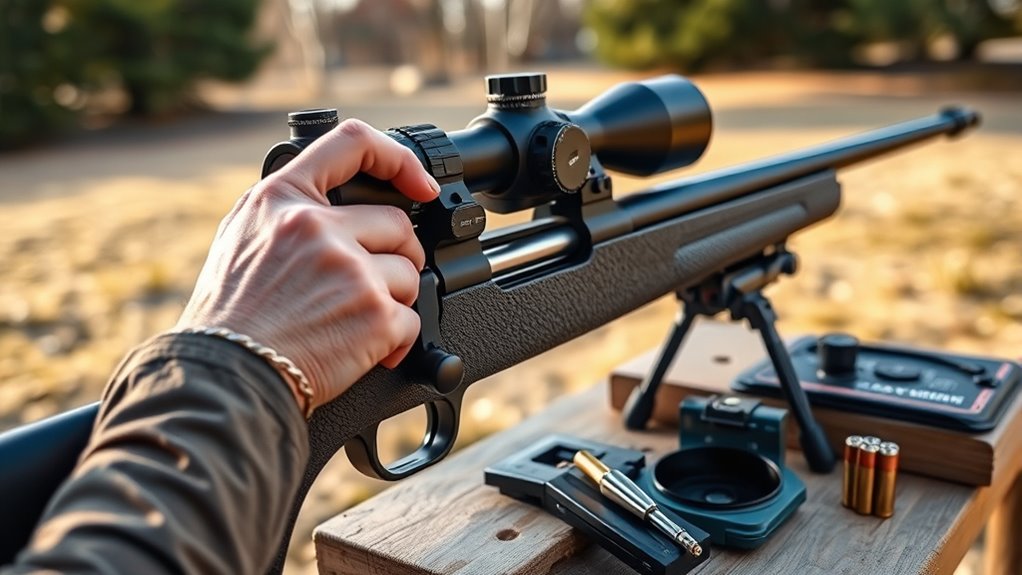
Before you begin sighting your Leupold scope, make sure your gear is ready and you have a stable shooting position. Start by checking that your rifle is clean and functioning properly. Verify your scope is securely mounted and tightened to avoid any movement during shooting.
Ensure your rifle and scope are properly prepared and securely mounted for a stable and accurate sighting experience.
Gather all necessary tools, such as a torque wrench or screwdrivers, to make any adjustments if needed. Next, find a flat, sturdy surface like a shooting bench or use a bipod or sandbags to steady your rifle. A stable position minimizes recoil impact and helps maintain consistency.
Make sure you’re comfortably supported, whether sitting or prone, so you can hold the rifle steady without strain. Lastly, double-check your ammunition matches your rifle’s specifications. Having the right ammo ensures accuracy during sighting.
Taking these steps before you start will make the sighting process smoother and more reliable.
Get to Know Your Leupold Scope’s Reticle and Controls
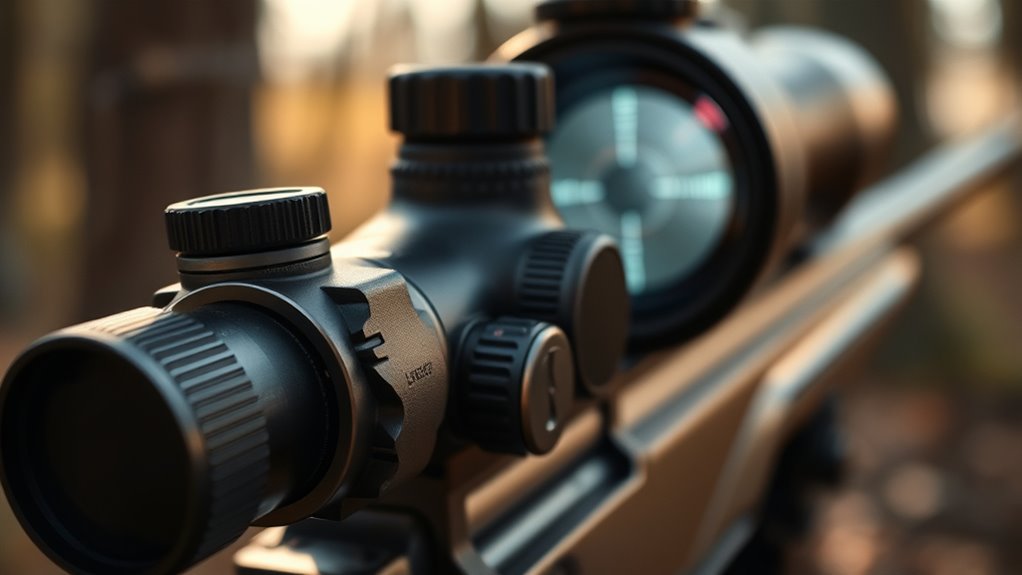
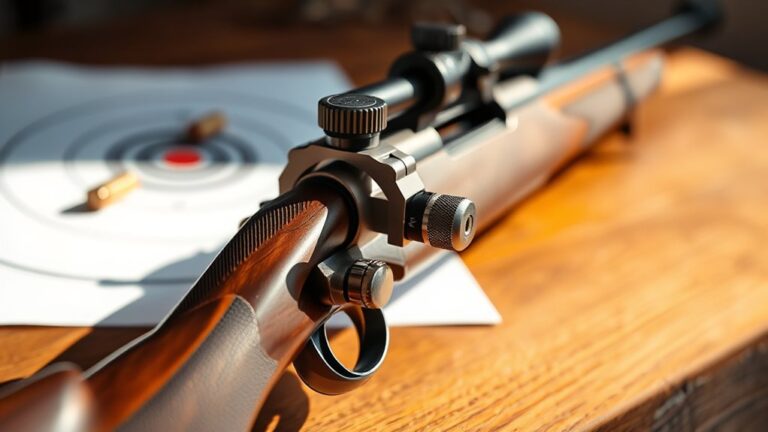
Once you’ve secured your rifle and gear, it’s important to familiarize yourself with your Leupold scope’s reticle and controls to make accurate adjustments. The reticle is your aiming point, often a crosshair or duplex pattern, designed to help you line up your shot precisely. Different models may feature illuminated reticles or specialized marks for windage and elevation holdovers, so check your scope’s manual to understand its specifics.
Next, locate the adjustment turrets. Typically, you’ll find two: one for windage (left/right) and one for elevation (up/down). Each click changes your point of impact by a set increment, usually measured in MOA or MIL.
Many Leupold scopes have tactile, audible clicks to help you track adjustments without guessing. Also, identify the parallax adjustment if your scope has one—it helps sharpen your target image at varying distances. Knowing these controls inside out will save you time and improve accuracy when zeroing your rifle.
Bore Sight Your Rifle to Align Your Leupold Scope
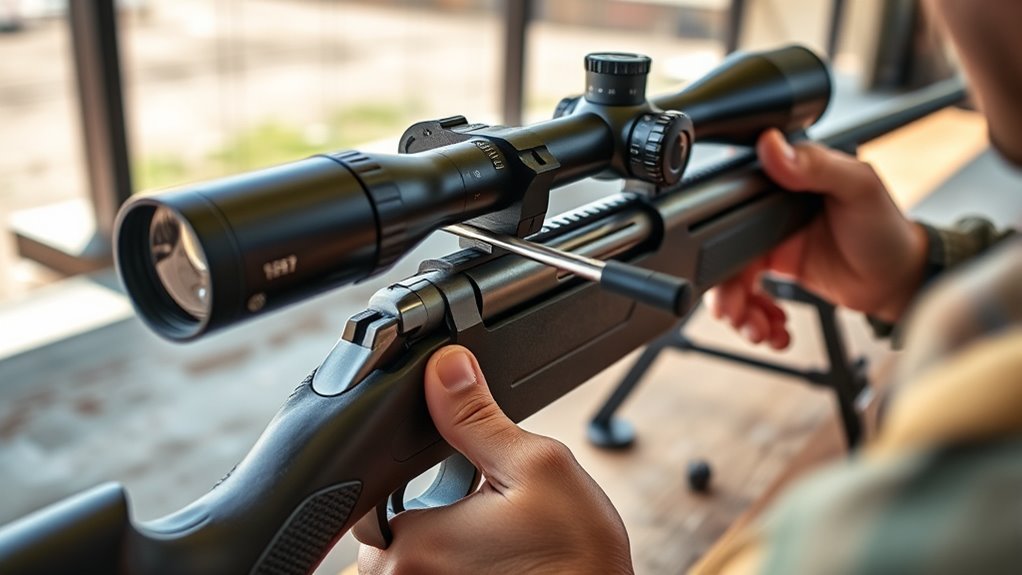
Before you start bore sighting, make sure your rifle is securely positioned and unloaded for safety. You’ll then look through the barrel to line up the target and adjust your Leupold scope’s reticle accordingly. This initial alignment sets the foundation for accurate shooting downrange.
Preparing Your Rifle
Although it might seem tempting to jump straight into zeroing your Leupold scope at the range, bore sighting your rifle first will save you time and ammunition.
Preparing your rifle properly guarantees your scope starts aligned close to the target.
Here’s how to get ready:
- Secure Your Rifle: Use a stable rest or shooting bench to minimize movement.
- Remove the Bolt: This lets you look straight down the barrel for bore sighting.
- Check Scope Mounts: Tighten all screws on your scope rings and mounts to prevent shifting.
These steps set you up for a smoother sighting process, allowing your Leupold scope to align more accurately once you begin range adjustments.
Skipping preparation can lead to wasted shots and frustration.
Aligning Scope Reticle
After securing your rifle and preparing it properly, the next step is to align your scope’s reticle with the bore of your barrel. This process, called bore sighting, helps you get your Leupold scope close to the target before live firing.
Begin by resting your rifle securely on a stable surface or sandbags. Remove the bolt or open the action so you can see down the barrel. Look through the bore and center the target.
Then, without moving the rifle, adjust your scope’s windage and elevation turrets until the reticle matches the same point you see down the barrel. This alignment saves time and ammo when you start live-fire zeroing.
Once aligned, you’re ready for fine-tuning at the range.
Take Your First Shots and Check Your Grouping
Now it’s time to take your first shots and see where they land on the target. Pay close attention to your shot placement and how tight your groupings are.
Use this information to make precise adjustments to your scope for better accuracy.
Assess Shot Placement
Once you’ve zeroed in your Leupold scope, it’s time to take your first shots and see where they land. Evaluating shot placement helps you understand how well your adjustments worked and what’s next.
Focus on these key points:
- Identify the Point of Impact – Note if your shots are hitting high, low, left, or right of your target’s center. This tells you how accurate your current zero is.
- Measure Distance from Aim Point – Use the reticle or a measuring tool to estimate how far your shots stray from your intended mark.
- Record Your Findings – Keep a log of shot placement and conditions. This data will guide any further scope adjustments.
Analyze Group Consistency
Evaluating where your shots land gives you a clear picture of accuracy, but grouping reveals how consistent your shooting is. After taking your first shots, closely inspect the cluster. A tight group means your scope and technique sync well, while a wide spread suggests inconsistencies.
Note how far apart your shots are and if they trend in a specific direction. Tracking this helps in refining your aim and settings.
| Shot Number | Distance from Center (inches) | Notes |
|---|---|---|
| 1 | 1.2 | Slightly left |
| 2 | 0.8 | Tight grouping |
| 3 | 1.5 | Slightly high |
| 4 | 1.1 | Consistent grouping |
| 5 | 0.9 | Centered cluster |
This data lets you judge your starting point effectively.
Adjust Based On Results
After taking several shots, you’ll want to carefully review your grouping to determine what adjustments are needed. This step is crucial for fine-tuning your Leupold scope’s zero.
- Evaluate the Grouping Location: Check if your shots consistently land left, right, high, or low of the target’s bullseye.
- Calculate Adjustment Values: Use your scope’s turret clicks (usually ¼ MOA per click) to decide how much you need to move the point of impact.
- Make Incremental Adjustments: Turn the windage and elevation turrets accordingly, then shoot another group to verify. Repeat until your shots cluster tightly on the bullseye.
Adjust Windage and Elevation to Zero Your Leupold Scope
Before you start adjusting, make certain your rifle is securely mounted and you’re at a proper distance for zeroing. Begin by focusing on windage, which controls left and right movement. Locate the windage turret, usually on the side of your Leupold scope, and turn it in small increments toward the direction your shots need to move.
For example, if your shots are hitting left, turn the turret to move the point of impact right. Next, adjust elevation to control up and down movement. The elevation turret, typically on top, should be turned to raise or lower your point of impact accordingly.
Confirm Your Zero at Different Distances
Once you’ve adjusted windage and elevation to zero your Leupold scope at your initial distance, it’s important to verify that your zero holds true at other ranges. This ensures your shots stay accurate whether you’re shooting close or far.
Verifying your scope’s zero at multiple distances ensures consistent accuracy near and far.
To confirm your zero at different distances:
- Shoot at multiple distances – Start by shooting groups at 25, 50, and 100 yards (or meters), checking where your bullets hit relative to the point of aim.
- Adjust your holdover – Note the bullet drop or rise at each distance. Use your scope’s reticle or turrets to compensate for these differences without changing your zero.
- Record your results – Keep track of the deviations at each range for future reference, so you know exactly how to modify for various shooting conditions.
Fine-Tune Your Leupold Scope and Troubleshoot Issues
Even with a properly zeroed Leupold scope, you might find small adjustments are needed to fine-tune your setup for peak performance. Start by confirming your scope’s turrets click crisply and move smoothly; any looseness can affect accuracy. If your point of impact shifts unexpectedly, check that the scope rings are securely tightened without overtightening.
Make minor elevation and windage tweaks while shooting from a stable rest, noting changes carefully. If your reticle appears blurry, adjust the ocular focus to sharpen the image. Inconsistent grouping or erratic impacts may signal issues like inconsistent ammunition or barrel fouling—address those before blaming the scope.
Also, verify your scope is properly mounted and hasn’t shifted after recoil. If you encounter parallax problems, adjust the parallax knob to match your target distance for a clear sight picture. Regularly inspect your scope for damage or loose parts, and keep lenses clean to maintain clarity.
These fine-tuning steps help you maintain precision and reliability in the field.
Frequently Asked Questions
How Do I Clean and Maintain My Leupold Scope?
You should gently clean the lenses with a soft brush or microfiber cloth to avoid scratches. Keep the scope dry and store it in a protective case. Regularly check for loose screws and avoid harsh chemicals when cleaning.
Can I Use My Leupold Scope for Hunting in Low Light?
Like a cat’s eyes glowing at dusk, your Leupold scope performs well in low light. You’ll appreciate its clarity and brightness, helping you spot game early morning or late evening without missing essential details.
What Is the Warranty Policy on Leupold Scopes?
Leupold scopes come with a lifetime warranty that covers defects in materials and workmanship. You don’t have to register it, and it’s transferable.
If something goes wrong, they’ll repair or replace your scope free of charge.
How Do I Choose the Right Leupold Scope Model for My Rifle?
Choosing the right Leupold scope means balancing your rifle’s purpose with your shooting style. You’ll want to take into account magnification, reticle type, and durability—precision meets practicality—so your setup feels natural and performs flawlessly in the field.
Are There Any Recommended Accessories for Leupold Scopes?
You’ll want lens covers, a scope level, and a sunshade to protect your Leupold scope and improve accuracy. Don’t forget a quality cleaning kit and a scope mount wrench for easy adjustments and maintenance in the field.
Conclusion
Now that you’ve gently guided your Leupold scope into perfect harmony with your rifle, you’re set for a smoother shooting experience. With patience and these simple steps, you’ve eased any guesswork out of your aim, making each shot feel more like second nature.
Remember, a well-sighted scope isn’t just about precision—it’s about confidence. So, keep fine-tuning, trust your setup, and enjoy the quiet satisfaction of hitting your mark with ease. Mastering how to sight a Leupold scope ensures your accuracy and enhances your overall shooting performance.