What Is 300 Blackout Ammo and How to Use It
300 Blackout ammo is a versatile cartridge designed specifically for use in short-barreled rifles and suppressed firearms. It offers reliable performance with effective stopping power at close to medium ranges, making it a popular choice among shooters.
This ammo is compatible with AR-15 platforms without requiring major modifications, enhancing its accessibility.
You can select subsonic rounds for quieter shooting or opt for supersonic rounds when longer range and higher velocity are needed. This flexibility makes 300 Blackout ammo ideal for tactical setups as well as hunting medium-sized game using expanding bullets.
For those looking to optimize their ammo choice and firearm setup, understanding the capabilities of this cartridge is essential.
Key Takeaways
- 300 Blackout ammo is a versatile cartridge designed for AR-15 rifles, optimized for short barrels and suppressed shooting.
- It uses the same case head as 5.56 NATO, allowing easy barrel swaps without major firearm modifications.
- Available in subsonic and supersonic loads, it balances quiet shooting with effective stopping power at close to medium ranges.
- Ideal for hunting medium game with expanding bullets, or for tactical use with heavier, controlled-recoil rounds.
- Proper firearm setup includes barrels from 9″ to 16″ and suppressor compatibility to maximize performance and stealth.
What Is 300 Blackout Ammo: And Where It Came From
Although you might not have heard of it before, 300 Blackout ammo was specifically designed to offer better performance in short-barreled rifles and suppressed firearms. It was developed by Advanced Armament Corporation in collaboration with Remington Defense around 2010. The goal was to create a cartridge that could deliver more effective stopping power at close to medium ranges, especially when using a suppressor.
You’ll find that 300 Blackout uses the same case head as the 5.56 NATO, making it easy to swap barrels on an AR-15 platform without modifying the bolt or magazines. This versatility means you can quickly switch between calibers for different missions or shooting preferences. Its design focuses on subsonic and supersonic loads, allowing you to optimize for quiet shooting or longer-range accuracy.
Understanding where 300 Blackout came from helps you appreciate its purpose: a practical, adaptable cartridge suited for modern tactical and hunting needs.
How 300 Blackout Ammo Differs From Other Cartridges
When comparing 300 Blackout to other cartridges, you’ll notice it stands out for its unique balance of versatility and performance. Unlike the standard 5.56 NATO, 300 Blackout delivers heavier bullets with greater energy at shorter ranges, making it ideal for close-quarters shooting and suppressed use. Its design allows you to use the same magazines and bolts as the AR-15, so adapting your firearm is simple without major modifications.
You’ll also find that 300 Blackout excels in subsonic loads, which other cartridges often struggle with, offering quieter shots when paired with a suppressor. While it may not match the long-range precision of cartridges like the 7.62 NATO, its adaptability across various bullet weights and velocities ensures effective performance in diverse situations. This combination of compatibility, power, and stealth makes 300 Blackout uniquely practical compared to many other rifle cartridges.
Choosing the Right 300 Blackout Ammo for Hunting and Shooting
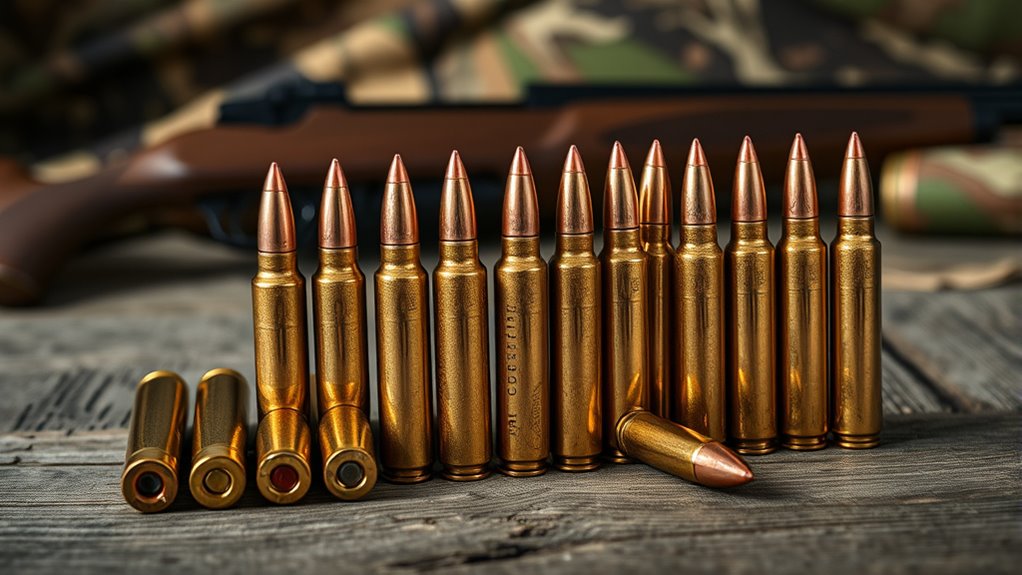
Since 300 Blackout ammo comes in various bullet types and weights, choosing the right one depends on your specific hunting or shooting needs. If you’re hunting medium-sized game, selecting expanding bullets like soft points or hollow points will provide effective terminal performance. For smaller targets or varmint control, lighter bullets with faster velocities work well.
When shooting suppressed, subsonic rounds with heavier bullets are ideal because they reduce noise and recoil, enhancing stealth and accuracy. On the other hand, supersonic rounds suit longer distances and deliver higher energy on impact. You’ll also want to contemplate bullet weight: lighter bullets (110-125 grains) generally offer flatter trajectories, while heavier ones (150-220 grains) provide better penetration and momentum.
Ultimately, matching your ammo choice to your firearm’s barrel length and twist rate guarantees peak performance. Take time to test different rounds at the range to see what works best for your hunting or shooting style.
Top Firearms and Setups for 300 Blackout Ammo
If you want to get the most out of your 300 Blackout ammo, choosing the right firearm and setup is essential. This round excels in AR-platform rifles, especially those with a 9-inch to 16-inch barrel. Suppressors pair well with subsonic loads, enhancing stealth and reducing recoil.
Here are some top firearm options and setups to ponder:
| Firearm Model | Recommended Setup |
|---|---|
| Smith & Wesson M&P 15 | 10.5″ barrel, suppressor-ready |
| SIG Sauer MCX | 9″ barrel, adjustable gas block |
| Daniel Defense DDM4 | 16″ barrel, standard handguard |
Each of these firearms offers reliability and versatility, allowing you to maximize the unique ballistics of 300 Blackout. Whether you prefer compact or longer barrels, these setups help you tailor your shooting experience to hunting or tactical needs.
How to Handle and Shoot 300 Blackout Ammo Safely
Although 300 Blackout ammo offers excellent versatility, handling it safely requires understanding its unique characteristics. First, always treat your firearm as if it’s loaded, and keep the muzzle pointed in a safe direction. Since 300 Blackout rounds can be subsonic or supersonic, make sure you know which type you’re using, as they behave differently in recoil and sound.
Wear proper eye and ear protection every time you shoot, especially because suppressed setups may alter noise levels. Before loading, inspect each round for defects or damage to avoid malfunctions. When shooting, use ammo specifically designed for your firearm’s barrel twist rate to ensure reliable accuracy and cycling.
Finally, follow all standard firearm safety rules: keep your finger off the trigger until ready, be aware of your target and what’s beyond it, and never mix 300 Blackout rounds with other calibers in your magazines. Safe handling guarantees you enjoy this versatile cartridge responsibly.
Reloading and Maintaining 300 Blackout for Best Performance
When you’re looking to get the most out of your 300 Blackout ammo, proper reloading and maintenance are essential. Start by selecting quality components—bullets, powder, primers, and brass—that match your intended use, whether supersonic or subsonic. Carefully follow load data from trusted sources to guarantee safety and consistency.
Maximize your 300 Blackout ammo’s potential with quality components and trusted load data for safety and consistency.
Pay attention to powder charges and seating depth, as these affect velocity and accuracy. Always inspect your brass for signs of wear or damage before reloading.
For maintenance, clean your firearm regularly to prevent fouling, which can affect performance and reliability. Use appropriate solvents and brushes designed for 300 Blackout’s specific pressures and barrel dimensions. Lubricate moving parts lightly to avoid buildup that might cause malfunctions.
Keeping your rifle well-maintained and using carefully reloaded ammo tailored to your needs will maximize accuracy, reliability, and longevity, making certain you get the best performance from your 300 Blackout rounds every time.
Frequently Asked Questions
Can 300 Blackout Ammo Be Used in Standard AR-15 Magazines?
Yes, you can use 300 Blackout ammo in standard AR-15 magazines without any issues. The rounds fit perfectly, so you won’t need special magazines, but always guarantee your rifle is properly chambered for 300 Blackout for safe use.
What Is the Typical Cost Comparison of 300 Blackout Ammo?
If you’re buying 300 Blackout, you’ll usually pay about 20-30% more than standard 5.56 ammo. For example, a box of 20 rounds might cost $25, while similar 5.56 rounds go for around $18.
Prices can vary depending on the manufacturer and availability. Premium or specialty loads for 300 Blackout may cost even more.
This price difference reflects the relative rarity and demand of the 300 Blackout cartridge compared to the widely used 5.56.
How Does Weather Affect 300 Blackout Ammo Performance?
You’ll notice 300 Blackout ammo performance changes with weather—cold air can slow bullets slightly, while humidity and altitude affect trajectory and velocity.
Adjust your aim and expect minor variations in accuracy during extreme conditions.
Are There Legal Restrictions Specific to 300 Blackout Ammo?
Sure, because everyone needs a special rulebook just for 300 Blackout ammo!
Actually, legal restrictions vary by state and country, so you’ll want to check local laws before buying or using it—don’t get caught playing ammo roulette!
What Are Common Myths About 300 Blackout Ammo Debunked?
You might’ve heard 300 Blackout is just a louder 5.56, but it’s designed for versatility and subsonic use. It’s not inherently less accurate or more restricted legally—those are common misconceptions you shouldn’t buy into.
Conclusion
Now that you know what 300 Blackout ammo is and how it stands apart, you might wonder if it’s truly as versatile as they say. The truth? It is. Whether you’re hunting or target shooting, this round adapts to your needs like no other.
So, when you pick up your firearm, remember: mastering 300 Blackout isn’t just about power—it’s about precision, safety, and respect for the craft. Using 300 Blackout ammo correctly ensures you get the most out of its unique capabilities. With the right knowledge and practice, 300 Blackout ammo can become your go-to choice for a wide range of shooting activities.
You’ve got this. Keep honing your skills and stay safe while enjoying the benefits of 300 Blackout ammo.